
Trap Draw in Greyhound Racing
 Available in US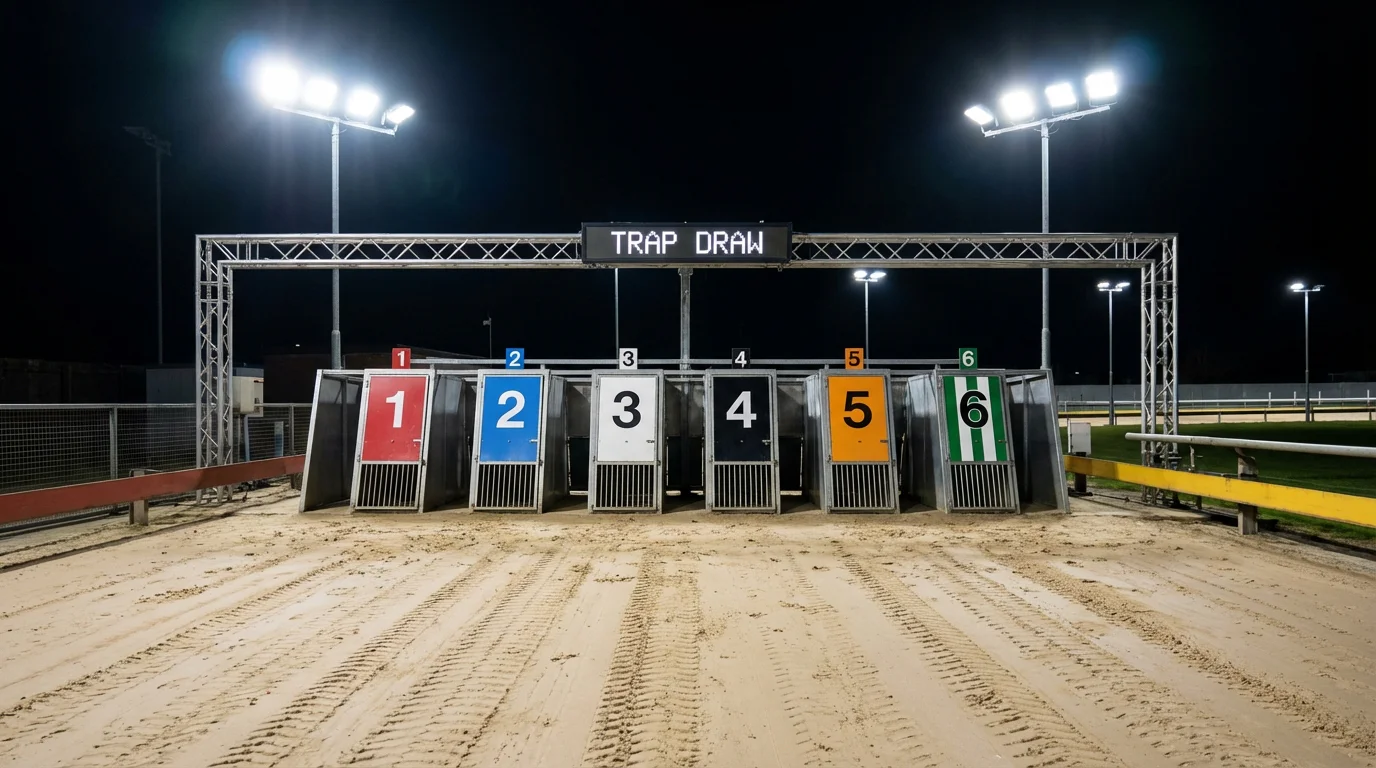
Six Traps, Six Stories — Why Starting Position Matters
In horse racing, the draw is determined by lot. In greyhound racing, it is determined by design. The racing manager at each UK track assigns every dog to a specific trap based on its running style, and that assignment is not random — it is an attempt to give each runner the best chance of a clean, competitive race. Understanding how and why traps are assigned, and what biases emerge despite the best intentions of the grading office, is one of the sharper analytical edges available to greyhound bettors. Get more race analysis at greyhoundbettingsitesuk.
The trap draw directly affects the first bend, and the first bend is where most greyhound races take shape. A dog drawn on the inside has a shorter path to the first turn. A dog drawn wide has more ground to cover but potentially less crowding. The dynamics of those opening seconds — who breaks fastest, who gets the rail, who gets boxed in — flow directly from where the dogs started. Every bet on a greyhound race is, in part, a bet on the trap draw.
The Seeding System — How Traps Are Assigned
Railers, Wide Runners and Middle Seeds
UK greyhound racing uses a seeding system that categorises dogs by their preferred running position on the track. A railer is a dog that naturally hugs the inside rail during a race. A wide runner takes a path toward the outside of the track. A middle seed runs between the two extremes. The racing manager observes each dog’s behaviour in trials and previous races and assigns a seed accordingly.
Trap assignments follow from these seeds. Trap 1 and Trap 2 are typically given to railers — dogs that want to be close to the inside from the moment the traps open. Trap 5 and Trap 6 go to wide runners who need space on the outside. Traps 3 and 4 are assigned to middle seeds or dogs whose running style is less pronounced in either direction.
The purpose of seeding is to prevent unnecessary interference. If a railer is drawn in Trap 6 and a wide runner in Trap 1, both dogs will cross paths in the opening strides as they seek their preferred running lines. That collision slows both runners, increases the risk of injury, and produces a worse race for bettors and spectators alike. Proper seeding minimises these conflicts by placing each dog on the side of the track where it naturally wants to be.
For bettors, seeding provides information. When you see a dog in Trap 1, you know the racing manager considers it a railer. That means you can expect it to break toward the rail from the off, seek to lead or track the leader on the inside, and potentially struggle if it is slow out of the traps and gets pushed wide by the dog in Trap 2. The trap number is a coded description of expected running behaviour, and incorporating it into your race analysis is essential.
How Seeding Interacts with Early Speed
Seeding is based on running line preference, not on early speed. A dog can be a confirmed railer but also a notoriously slow starter. This combination is problematic: the dog wants to be on the rail but cannot get there quickly because faster dogs from adjacent traps reach the first bend ahead of it. When a slow-starting railer is drawn in Trap 1, it may get crowded by dogs breaking faster from Traps 2 and 3, forcing it off its preferred line.
Conversely, a fast-starting wide runner in Trap 6 can be devastating. If it breaks sharply and clears the field on the outside, it avoids all first-bend traffic and can sweep into the lead with a clear run. The racecard remarks will tell you about a dog’s early speed — look for QAw (quick away) or SlAw (slow away) in the recent comments to assess how the trap draw and the dog’s break speed are likely to interact.
Track-Specific Trap Bias at Major UK Venues
Despite seeding, trap biases exist at most UK tracks. The geometry of each circuit — the distance from the traps to the first bend, the tightness of the bends, the width of the straight — creates structural advantages for certain trap positions. These biases are not large enough to override form entirely, but they are consistent enough to factor into your analysis.
At Crayford, which was one of the tightest circuits in the UK before its closure in January 2025, inside traps historically held a modest advantage. The sharp bends rewarded dogs that reached the rail early, and the short run from the traps to the first turn gave inside-drawn dogs less ground to cover. Trap 1 at Crayford traditionally produced a slightly higher win percentage than the statistical average across all traps.
At wider tracks like Nottingham and Towcester, the trap bias is less pronounced. The longer straights and more sweeping bends give all six dogs room to find their preferred running lines, which reduces the structural advantage of any single trap position. At these venues, early speed and overall ability matter more than the specific trap number.
Romford presents an interesting case. Its tight, fast circuit favours early pace above all else. The dog that leads into the first bend at Romford wins a disproportionately high percentage of races, regardless of trap position. This means that at Romford, the trap draw matters less than the dog’s break speed — though inside traps still hold a marginal advantage when all else is equal.
Perry Barr, Monmore, Hove, and Sheffield each have their own subtle biases, influenced by circuit design, trap positioning, and the typical calibre of runners. The most practical way to assess trap bias at any track is to review the results data over a recent sample — say, the last three to six months. Some data providers and tipster sites publish trap statistics by track, and the Racing Post’s results archive allows you to filter by track and trap for your own analysis. Look for traps that consistently outperform or underperform the expected 16.7 percent win rate (one win in six for a random trap in a six-dog field).
Weather, Track Conditions and Trap Bias Shifts
Trap biases are not fixed. They shift with track conditions, and the most significant factor is weather. All UK greyhound tracks use sand surfaces, and the condition of that sand changes with rain, temperature, and track maintenance. Those changes can amplify, reduce, or even reverse the normal trap biases at a given venue.
Heavy rain saturates the sand, making the track slower and heavier. On a waterlogged track, the inside running rail can become particularly churned up because dogs preferentially run close to it, compacting the sand into a less forgiving surface. In these conditions, inside traps may lose their normal advantage as the ground closest to the rail becomes the slowest part of the track. Dogs drawn wider can benefit from running on fresher, less disturbed sand.
Conversely, a dry, firm track in summer typically favours inside traps at tight circuits. The sand is fast and even across the width of the track, and the geometric advantage of the shorter inside path to the first bend operates without the counterweight of poor ground conditions.
Temperature also plays a role. Cold evening meetings in winter produce firmer, slower sand. Hot summer afternoons can make the track fast to the point where early speed becomes overwhelming and front-runners dominate regardless of draw. Pay attention to the time of year and the weather forecast when assessing trap bias — a bias that held true through the summer may weaken or disappear in the winter.
The practical approach is to watch the first two or three races on a card before betting heavily on later races. If inside traps are winning disproportionately in the early races, the conditions likely favour railers throughout the meeting. If the results are spread evenly across all traps, conditions are neutral. This in-running assessment is more reliable than applying historical bias data from a different season or different weather pattern.
The Trap Is the Start, Not the Finish
Trap draw analysis is a powerful tool, but it is one input among several. A dog in the best trap at the best track in the best conditions still needs to have the form, fitness, and ability to win the race. Trap bias does not override class. What it does is tilt the probability slightly in one direction, and in a sport where margins are measured in fractions of a second, a slight tilt can be the difference between a winning and losing bet. Also read our greyhound trap challenge betting.
Build the trap draw into your analysis alongside form, grade, running style, and race remarks. Use it to separate closely matched runners, to identify potential interference risks, and to spot dogs whose odds do not fully account for their positional advantage or disadvantage. The trap is where the race begins. What you do with that information is what separates a sharp greyhound bettor from a casual one.
