
UK Greyhound Racing Tracks
 Available in US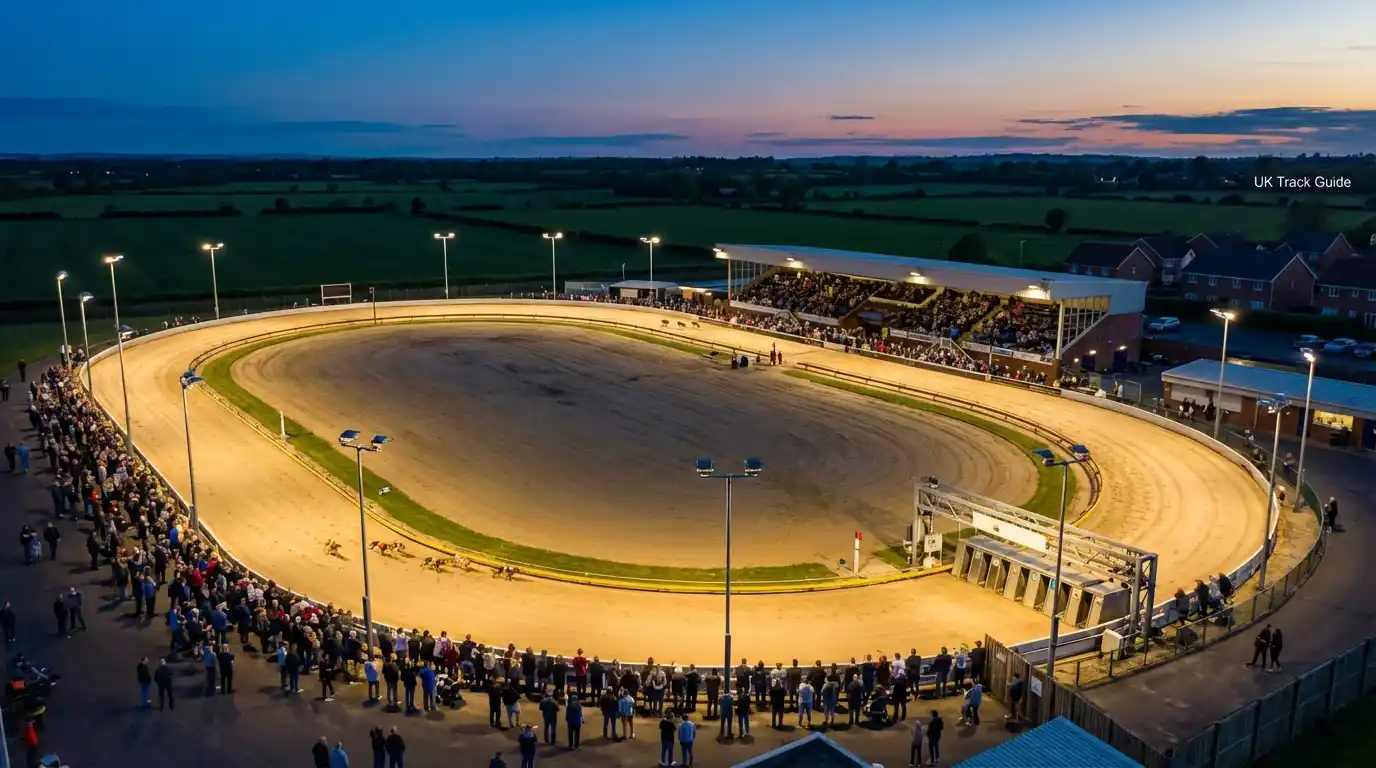
Eighteen Tracks, Eighteen Different Races
UK greyhound racing runs across 18 GBGB-registered tracks (source: GBGB Racecourses), each with its own circuit dimensions, race distances, running characteristics, and quirks that affect the outcome of every race staged there. To a casual viewer, all greyhound tracks look similar — an oval of sand with six traps at one end and a finishing line at the other. To a serious bettor, each track is a distinct venue with distinct demands, and knowing how those demands interact with individual dogs’ abilities is one of the less obvious but most consistent edges available.
A dog that dominates at Romford’s tight, fast 400-metre circuit may struggle at Nottingham’s wider 480-metre track. A stayer that thrives at Towcester’s long straights might be beaten for pace at Crayford’s compact layout. These are not marginal differences. They are structural, and they repeat across hundreds of races. The track guide that follows covers the major venues and what bettors need to know about each one. Find more track guides at greyhoundbettingsitesuk.
Major Track Profiles
Romford
Romford is one of the busiest tracks in the UK, running multiple meetings per week and hosting a full calendar of both BAGS afternoon and evening racing. The circuit is tight with sharp bends and a standard distance of 400 metres. The run from the traps to the first bend is short, which places a premium on early speed. Dogs that break fast and reach the rail quickly have a significant advantage. Front-runners thrive here; dogs that need time to find their stride often find themselves boxed in before they have built momentum.
For bettors, Romford rewards attention to break speed and trap draw. The racecard remarks are particularly informative at this track — QAw comments carry more weight here than at larger circuits because early pace is so decisive. Inside traps hold a slight structural edge, but a fast starter from any trap can dominate if it reaches the first bend in the lead.
Hove
Hove, located near Brighton on the south coast, is one of the most respected tracks in UK greyhound racing. It runs standard distances of 285 metres for sprints and 515 metres for middle-distance races, with a wider circuit of 455 metres circumference that allows dogs more room to manoeuvre. The bends are less severe than at tighter venues, which reduces the impact of trap draw and places more emphasis on raw speed and sustained pace.
Hove hosts regular Category 1 open races and has historically been a venue for high-quality graded racing. The standard of runner tends to be strong, particularly in the upper grades, making form analysis more reliable and outsiders less likely to cause upsets. Bettors targeting Hove should focus on time comparisons and grade performance rather than trap bias, which is relatively neutral at this circuit.
Monmore Green
Monmore, located in Wolverhampton, runs races over distances from 264 metres (sprint) to 630 metres (staying). The standard middle distance is 480 metres. The track is mid-sized with a fair layout that does not dramatically favour any particular running style. It is known for competitive racing across all grades and a strong base of regular trainers whose dogs are familiar with the circuit.
For bettors, Monmore offers good value opportunities because the regular trainer-track combinations produce consistent, reliable form. Dogs that have been racing at Monmore for several months develop a track familiarity that new arrivals lack, and this home advantage is worth noting when assessing a field. Monmore also hosts notable open competitions throughout the season.
Nottingham
Nottingham has one of the larger circuits in UK greyhound racing, with a standard distance of 480 metres and a wide, galloping track that suits dogs with stamina and sustained speed. The run to the first bend is longer than at compact tracks, which gives all six dogs more time to find their positions and reduces first-bend crowding. This makes Nottingham a fairer track in terms of trap draw — the structural advantage of inside traps is diminished by the extra room.
Nottingham hosted the English Greyhound Derby in 2019 and 2020 when Towcester was temporarily closed, and it remains a regular venue for high-profile open races including the 2025 St Leger (source: GBGB). The quality of racing at Nottingham, particularly on big-meeting nights, is among the best in the country. Bettors should note that the open, galloping nature of the track tends to favour class runners over front-running specialists — a dog that leads at Romford may be overhauled in the finishing straight at Nottingham by a stronger finisher.
Towcester
Towcester holds a unique position in UK greyhound racing as a relatively modern addition that quickly became a major venue. It first hosted the English Greyhound Derby in 2017 after Wimbledon’s closure. Following a period of administration in 2018, the track reopened in 2020 and has hosted the Derby continuously since 2021, establishing itself as the event’s permanent home (source: GBGB). The track features long straights and wide, sweeping bends, producing a true galloping test that rewards stamina and finishing speed. The Derby is run over 500 metres, while the standard graded distance is 480 metres. The circuit circumference is 420 metres, one of the largest on the UK calendar.
The spacious layout means trap bias is minimal. Dogs with strong finishing pace perform well here, and form from other large circuits like Nottingham tends to translate better to Towcester than form from tight tracks. For ante-post bettors targeting the Derby and other major Towcester events, trial times at the venue are the most valuable data point.
Other Notable Tracks
Crayford in south-east London was one of the tightest circuits in the UK, with sharp bends that favoured inside-drawn railers. It operated over a standard distance of 380 metres before closing permanently in January 2025. Sheffield runs over 480 metres with a mid-sized circuit that produces fair, competitive racing. Sunderland, Doncaster, and Kinsley in the north offer regular BAGS racing with solid graded cards. Central Park in Kent and Yarmouth on the east coast complete the circuit, each with their own distance profiles and track characteristics.
Belle Vue in Manchester was historically one of UK greyhound racing’s most famous venues, and its legacy looms large in the sport’s culture, though the current track landscape has shifted away from the north. The concentration of tracks in the south-east and Midlands reflects the modern geography of the sport, with fewer northern and Scottish options available since several closures in recent years.
Track Dimensions and Their Betting Implications
The circumference of a track determines how the race unfolds. Smaller circumferences (under 400 metres) produce tighter bends, shorter straights, and a compressed race where the first bend is decisive. Larger circumferences (over 420 metres) create wider bends, longer straights, and a race that unfolds over a greater distance, allowing more tactical variation and recovery from poor starts.
Distances offered at each track depend on the circuit layout. Most tracks offer a sprint, a standard middle distance, and at least one staying distance. The specific metres differ — Romford’s standard is 400, Hove’s is 515, Nottingham’s is 480 — which means a dog’s time at one track is not directly comparable to its time at another. A 28.50 over 480 metres at Nottingham tells you nothing about how that dog would run 400 metres at Romford, because the distances, bends, and track dynamics are entirely different.
When assessing a dog that is racing at a track for the first time, look at its form over similar distances at tracks with comparable circumferences. A dog with strong form at the tight Crayford circuit may adapt well to the similarly compact Romford. A dog that excels over Nottingham’s wide 480-metre trip is more likely to handle Towcester’s similar layout than Crayford’s sharp turns. These cross-track comparisons are imperfect, but they are better than ignoring the venue factor entirely.
Choosing the Right Track for Your Betting
Not all tracks suit all betting approaches. If your strength is trap draw analysis and early-speed assessment, focus on tighter tracks like Romford, where those factors have the greatest influence on outcomes. If you prefer form-based analysis and time comparisons, wider tracks like Nottingham, Hove, and Towcester produce more predictable results where class tends to prevail over luck.
Many experienced greyhound bettors specialise in two or three tracks rather than spreading their attention across all eighteen. Specialisation builds familiarity with the local trainer pool, the track’s grading patterns, typical running styles, and condition-specific biases. You learn which trainers prepare their dogs well for specific distances, which traps run hot in wet weather, and which grades produce the most competitive racing. That accumulated knowledge is difficult to replicate if you are dipping in and out of twelve different venues.
Live streaming through bookmakers like bet365, Betfred, and Coral makes it possible to watch racing from any UK track on any given night. Use that access to study tracks you are considering specialising in before committing your bankroll. Watch a full evening’s racing, note the results against the racecard data, and assess whether the track’s patterns match your analytical strengths. The right track for your betting is the one where your skills produce the most accurate predictions — and that is rarely the same track for every bettor. Also read our distances and race types.
The Circuit That Suits You — Finding Your Track
Greyhound racing in the UK is not a single, homogeneous product. It is eighteen tracks with eighteen different characters, running different distances over different layouts in different parts of the country. The bettor who treats all tracks as interchangeable is giving up an edge to the one who understands the distinctions. Track knowledge is not glamorous, and it does not produce overnight profits. What it does produce is a consistent, structural advantage that grows with every meeting you watch and every racecard you analyse at your chosen venue. Find the tracks that reward your approach, learn them thoroughly, and let the generalists spread themselves thin across the rest.
