
Greyhound Match Betting Explained
 Available in US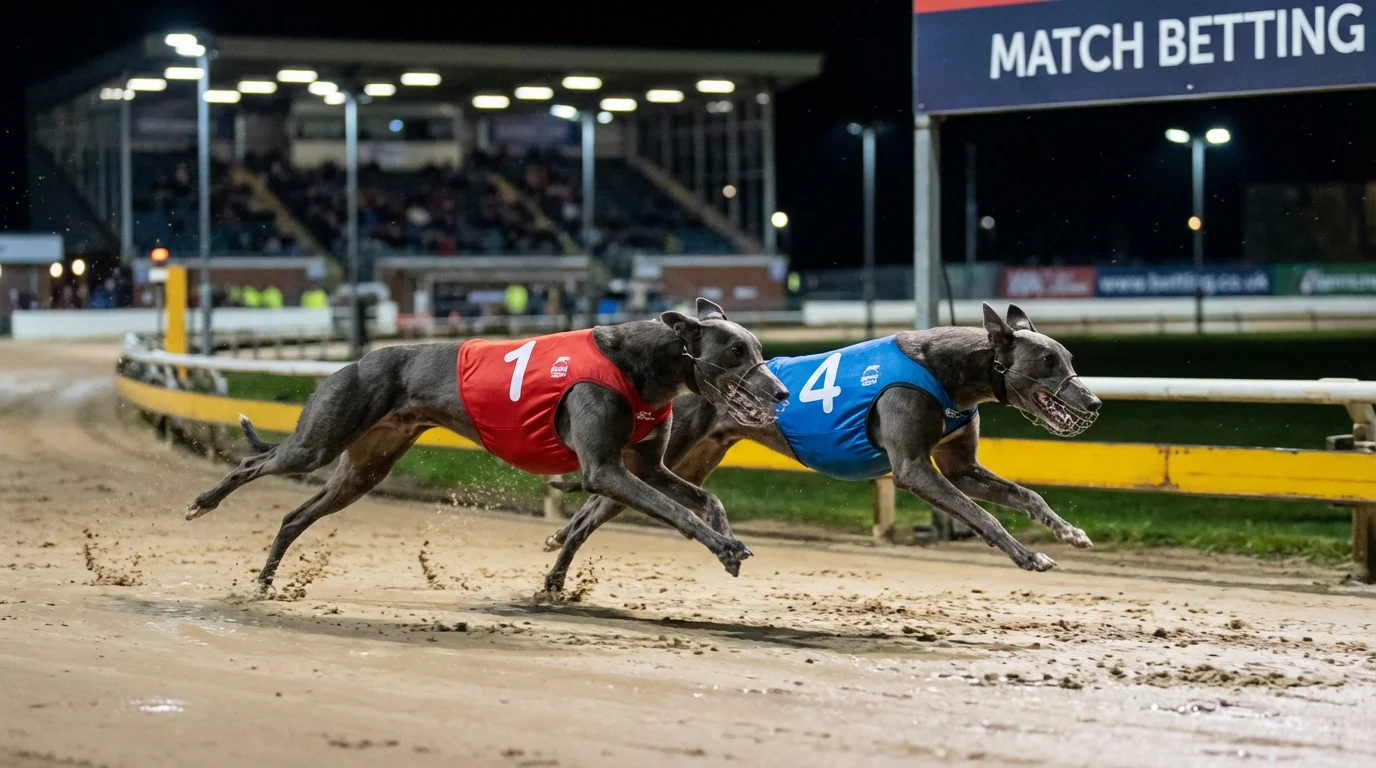
Two Dogs, One Question — The Simplest Bet in Greyhound Racing
A match bet strips a greyhound race down to its simplest form. Forget the six-dog field, forget the finishing order, forget whether your dog wins the race at all. A match bet asks one question: which of these two dogs will finish ahead of the other? If your selection finishes third and the rival finishes fourth, you win. If your dog trails home fifth but the matched opponent is sixth, you still win. The overall race result is irrelevant. Only the head-to-head matters. Find more bet type guides at greyhoundbettingsitesuk.
Match betting is underused in greyhound racing. Most punters default to win, each-way, or forecast markets without considering that a match bet might capture their view more precisely and at better value. If your analysis tells you that Dog A is likely to beat Dog B — but you are not confident Dog A will win the race outright — a match bet lets you profit from that opinion without needing the dog to cross the line first. It is a market that rewards comparative analysis rather than absolute prediction, and in a six-dog field where interference and racing luck routinely upend the finishing order, that distinction has real value.
How Match Bets Work
Bookmakers offering match bets on greyhound racing select pairs of dogs from the same race and price them against each other. You choose which dog in the pair will finish ahead of the other. The odds on each dog in the match reflect the bookmaker’s assessment of their relative chances, accounting for form, trap draw, and running style.
A typical match bet might look like this: Dog A at 4/5, Dog B at evens. The market is saying Dog A is slightly more likely to beat Dog B, but it is close. If you believe Dog A will outperform Dog B based on your form analysis, you back Dog A at 4/5. If Dog A finishes anywhere ahead of Dog B in the final result — first and third, second and sixth, fourth and fifth — your bet wins. If Dog B finishes ahead of Dog A, or if the two finish in a dead heat for the same position, the bet loses or is voided depending on the operator’s rules.
Match bets are settled on the official finishing order of the race. Non-runners typically void the match bet, with stakes returned to the bettor. If one of the matched dogs is withdrawn before the race and a reserve runner replaces it, the match bet involving the withdrawn dog is voided. Always check the specific settlement rules at your bookmaker, as minor variations exist between operators.
Not all bookmakers offer match betting on every greyhound race. The market is more commonly available on evening cards and feature meetings than on afternoon BAGS fixtures. bet365 and Betfair are among the operators most likely to offer greyhound match bets, but availability fluctuates and is worth checking on a meeting-by-meeting basis.
Identifying Match Bet Value from Form
The analytical process for match betting differs from win betting in a subtle but important way. When you assess a dog for a win bet, you are comparing it against the entire field. When you assess a match bet, you are comparing it against a single opponent. The form factors that matter most are the ones that distinguish these two dogs from each other, not the ones that position them within the wider field.
Start with recent form at the same track and distance. If both dogs have been racing at the track where tonight’s race is held, you have a direct basis for comparison. Look at their recent times over the distance — not just the best time, but the average and the consistency. A dog whose last four times are 29.10, 29.15, 29.20, and 29.05 is more reliable than one showing 28.90, 29.50, 29.30, and 29.60, even though the second dog has posted a faster single time.
Trap draw interaction is particularly relevant to match bets. If Dog A is in Trap 1 and Dog B is in Trap 5, consider how the first bend is likely to play out. Will one dog get a cleaner run than the other based on their starting positions? If Dog A is a railer in Trap 1 and Dog B is a wide runner in Trap 5, they may run entirely different races with minimal interference between them. In that scenario, the match bet becomes a straightforward comparison of pace and finishing speed. If both dogs are drawn on the same side of the track — say Traps 2 and 3 — there is a higher chance of direct interference, which introduces randomness that favours the each-way match bettor who needs their dog to finish ahead, not necessarily win the race.
Race remarks are valuable match bet data. If Dog A has been bumped in two of its last three runs (Bmp1, Crd3) and Dog B has had clear runs (EvCh), their recent form figures are not directly comparable. Dog A’s poor results may reflect bad luck rather than inferior ability. If the match bet odds are set primarily on finishing positions — which they often are — a bumped dog returning to an unhindered run represents a potential value play in the head-to-head market.
Running style compatibility also matters. Two dogs with conflicting running styles — one that leads, one that closes — are easier to assess in a match bet because their performance is less likely to be correlated. They run different races. Two dogs with identical running styles — both front-runners, both closers — are harder to separate because their fates in the race are more intertwined. If both want to lead, one will fail to get the front position, and predicting which one depends on break speed and trap draw.
Match Bets vs Win and Each-Way on the Same Dog
The value of a match bet becomes clearest when you compare it directly with a win or each-way bet on the same dog. Suppose your analysis identifies Dog A as superior to Dog B, but Dog A is only the third or fourth best dog in the overall race — a strong performer but not the likely winner.
A win bet on Dog A might be available at 5/1, reflecting its realistic but not dominant chance of winning the six-dog race outright. An each-way bet at 5/1 doubles your stake for a place return if Dog A finishes second. A match bet on Dog A to beat Dog B might be available at 4/5 — a much shorter price, but a much higher probability of winning.
The expected value calculation depends on your assessment of the probabilities. If you believe Dog A has a 25 percent chance of winning the race and a 60 percent chance of beating Dog B, the match bet at 4/5 offers better expected value than the win bet at 5/1 for most staking approaches. The win bet pays more when it lands, but it lands less frequently. The match bet pays less but lands more often, and over a series of bets the higher strike rate can produce more consistent returns.
Match bets also avoid the dead money problem that plagues each-way betting at short odds. If Dog A is 5/2 and you back it each way, the place return on a second-place finish is modest. A match bet on Dog A against its nearest rival might pay a similar return but with a higher probability, because you need Dog A to finish ahead of one specific dog rather than in the top two of the overall field.
The limitation of match betting is availability. Not every race offers match bet markets, and even when they are available, you may not find a pairing that captures the comparison you want to make. Match betting is a supplementary market — one more tool for expressing your view on a race — rather than a primary betting approach. But for the punter who thinks in terms of comparative assessment rather than absolute outcomes, it is a consistently undervalued option.
The Head-to-Head Edge — Thinking in Pairs
Match betting trains a useful analytical habit: thinking about greyhound races as a series of individual duels rather than a single contest. In any six-dog race, there are fifteen possible head-to-head pairings. The dog that wins the race wins all five of its match-ups. The dog that finishes second wins four. And so on. When you start seeing a race as a matrix of pairings rather than a single finishing order, your understanding of relative form deepens. Also read our greyhound exchange betting.
Even when you do not place a match bet, the match-bet mindset improves your analysis of win and each-way markets. Asking “will Dog A beat Dog B?” about each pairing in the field forces you to think about direct comparisons rather than abstract assessments. It grounds your analysis in specifics — trap draw interactions, running style clashes, speed differentials — rather than the general impressions that often drive win betting. The head-to-head question is a more precise question, and more precise questions produce better answers.
