
Starting Price in Greyhound Racing
 Available in US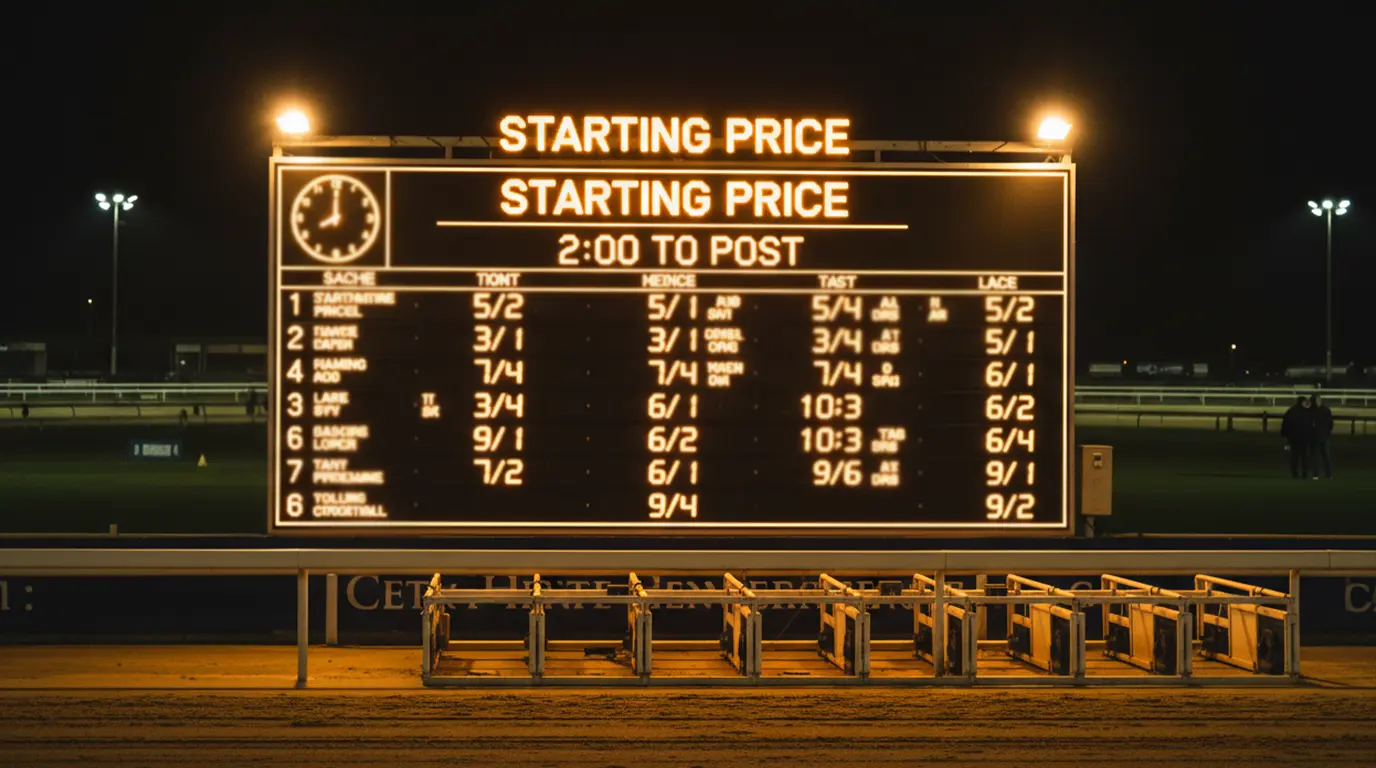
The Price That Forms in the Final Seconds
Starting price — SP — is the official odds of a greyhound at the moment the traps open. It is determined by the on-course betting market in the closing moments before the race, and it serves as the default settlement price for any bettor who did not take a fixed early price. If you placed a bet at SP, your return is calculated using whatever odds the dog carried at the off. If you took a fixed price before the race, the SP is still relevant because best odds guaranteed policies use it as the comparison point. Find more odds guides at greyhoundbettingsitesuk.
In horse racing, the SP is shaped by hours of market activity, with morning prices, lunchtime adjustments, and a deep pool of on-course bookmaker activity creating a well-informed final price. In greyhound racing, the SP formation process is compressed, volatile, and often surprising. The market forms late, the liquidity is thin, and the price your dog starts at can differ sharply from the early show. Understanding how and why this happens is essential for any greyhound bettor making decisions about when to take a price and when to let the SP do the work.
How SP Is Formed in Greyhound Racing
The starting price for a greyhound race is determined by the odds offered by on-course bookmakers in the ring at BAGS meetings and evening fixtures. A team of SP reporters — employed by the official SP reporting service — records the prices displayed by on-course bookmakers at the moment the traps open and calculates the returned SP from the median of available prices.
The process sounds straightforward, but the practical reality is messier. On-course greyhound betting is a fraction of the size of the on-course horse racing market. At many greyhound meetings, particularly afternoon BAGS fixtures, the number of on-course bookmakers is small and the volume of money passing through the ring is modest. This means the SP is formed from a thinner sample than in horse racing, which makes it more susceptible to distortion by relatively small amounts of money.
A single large on-course bet can move the SP of a greyhound significantly. If one punter places two hundred pounds on a dog in a market where the total on-course activity is a thousand pounds, that single bet represents 20 percent of the market’s volume. In horse racing, the same two hundred pounds would be a rounding error. This thinness is the defining characteristic of greyhound SP formation and the primary reason why SP surprises are more common on the dogs than on the horses.
The official SP is published after the race and is available on results services, bookmaker sites, and data providers. It is the price used to settle all SP bets and the price against which BOG claims are measured. For the avoidance of doubt: the SP is always the returned price, not the early show price or any bookmaker’s individual price.
SP Volatility Compared to Horse Racing
The volatility of greyhound starting prices is markedly higher than in horse racing, and the reasons are structural rather than incidental. In horse racing, prices are available from early morning, the market adjusts over hours, and by the time the race starts, the SP reflects a deep consensus of thousands of individual betting decisions. In greyhound racing, the price formation window is measured in minutes, and the consensus is formed from a much smaller pool of bets.
This volatility manifests in several ways. Dogs that show 4/1 in the early market can start at 7/1 or 5/2 with no obvious explanation beyond the pattern of late money. Favourites can be displaced in the final two minutes — a dog showing 6/4 favourite can start at 5/2 if late money arrives for a rival. Outsiders can shorten dramatically if a single informed punter backs them on course.
For bettors, this volatility is both a risk and an opportunity. The risk is that taking SP exposes you to unpredictable price movements. The opportunity is that the thin market creates frequent mispricings — dogs that are better value at SP than their early price suggested, and dogs whose SP drifts to a level that represents genuine value. BOG captures the upside of these movements automatically if you have taken an early price. Without BOG, you are at the mercy of whichever direction the market moves.
One useful pattern: greyhound SPs tend to drift more often than they shorten. The late money in greyhound markets is typically less concentrated than in horse racing, which means there are fewer strong late moves to back specific dogs. The overall effect is a slight bias toward SP prices being higher than the early show. This is one of the structural reasons why BOG is so valuable on greyhound racing — the drift happens often enough to deliver a meaningful cumulative benefit.
When to Take SP vs Fixed Odds
The decision between taking a fixed early price and accepting the SP is one of the most frequent judgment calls in greyhound betting. The right answer depends on the specific circumstances of the race, the availability of BOG, and your assessment of how the market is likely to move.
If BOG is available at your bookmaker, the decision is simple: take the early price. BOG guarantees you the best of both worlds — your fixed price or the SP, whichever is higher. There is no scenario where taking an early price at a BOG bookmaker produces a worse outcome than taking SP. This is the single strongest argument for always taking early prices at BOG-covered operators.
Without BOG, the calculation is more nuanced. Take the early price when you believe the dog will shorten. If your analysis suggests the dog is underpriced at the early show — perhaps because you have identified improving form or a favourable draw that the market has not yet accounted for — locking in the early price protects you against the contraction. If the dog does shorten, you hold a better number than SP bettors.
Accept SP when you believe the dog is likely to drift. If the early price looks too short — perhaps the dog is over-bet as a favourite due to name recognition rather than current form — waiting for the SP may deliver a better price. This is a riskier approach because you cannot predict drifts with certainty, and the dog might shorten instead. But for dogs at very short prices where you are only interested in betting at a specific value threshold, SP gives you the market’s final word.
There are also situations where SP is the only practical option. If you are betting on a race at the last minute — perhaps watching a live stream and spotting something in the paddock that changes your view — you may not have time to compare early prices across bookmakers. In those cases, SP is a reasonable default, accepting that you will sometimes get a better price and sometimes a worse one.
The Last Number — Making SP Work in Your Betting
Starting price is the market’s final opinion on a greyhound’s chances, formed under pressure, at speed, and with imperfect information. It is not a sophisticated number. It is not always right. But it is the number that settles your bets, and understanding its quirks — the volatility, the thin formation, the drift bias — gives you a framework for deciding when to trust it and when to act before it. Also read our greyhound racing odds explained.
The practical takeaway is straightforward. If you have access to BOG, always take early prices and let the guarantee handle the SP comparison for you. If you do not have BOG, develop a view on likely price movements for each race and act accordingly — take early if you expect a shortening, accept SP if you expect a drift. And in all cases, track the relationship between early prices and SPs over time at the tracks you bet on most frequently. The patterns are not random, and the bettor who understands the rhythm of SP formation at a specific venue holds a small but genuine edge over the one who bets blind.
