
Greyhound Tricast Betting
 Available in US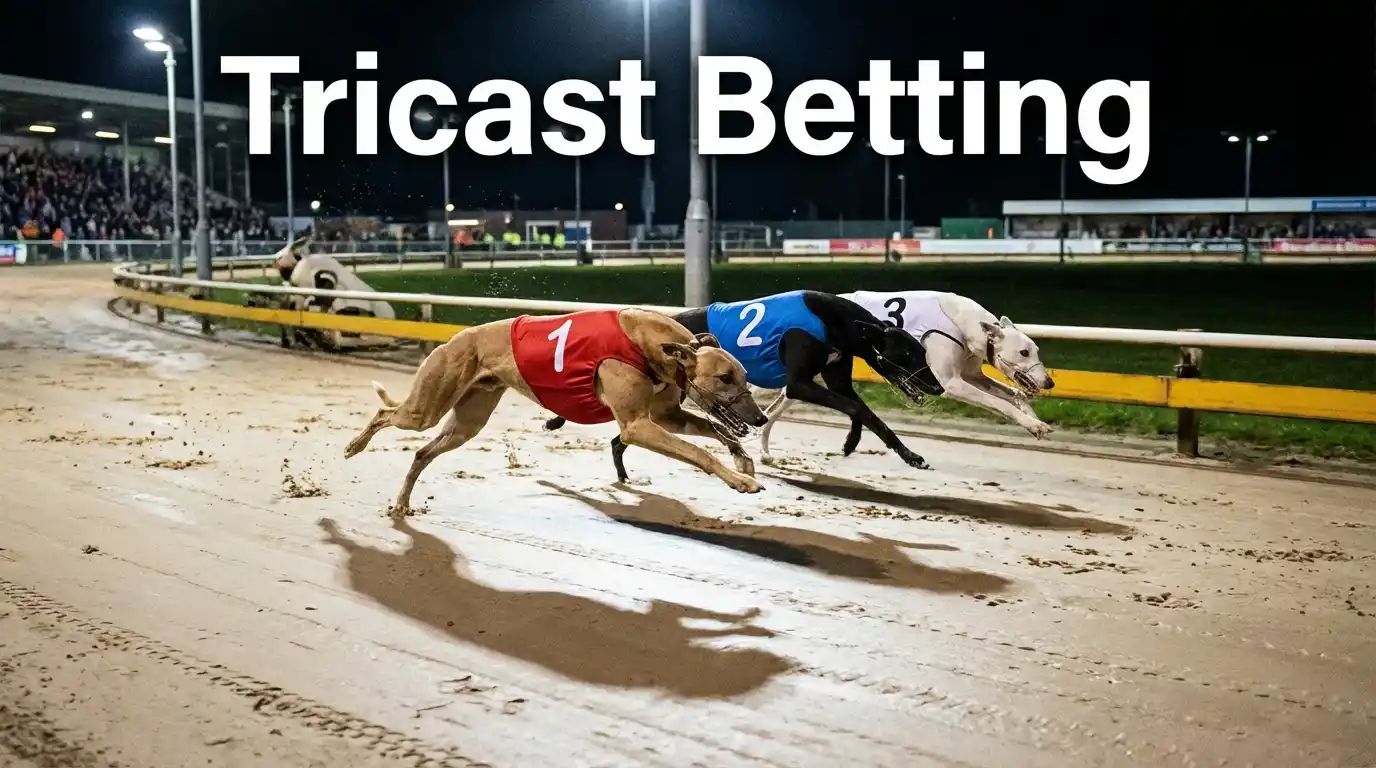
Three Dogs, One Precise Call
A tricast bet asks you to predict the first three finishers of a greyhound race in the exact order they cross the line. In a six-dog field, that means selecting the winner, the runner-up, and the third-place finisher — and getting the sequence right. The difficulty is obvious. The reward, when it lands, can be transformative: computer tricast dividends regularly return fifty, a hundred, or even several hundred times the original stake. Find more bet type guides at greyhoundbettingsitesuk.
Tricast betting sits at the more advanced end of greyhound wagering. It demands the same form analysis and race-reading skills as a forecast bet, extended to an additional finishing position. But the six-dog fields in UK greyhound racing make tricasts more achievable than in larger-field horse racing, where predicting the exact top three from a field of twelve or more runners is an exercise in hope. With six runners, the total number of exact 1-2-3 permutations is 120. That is still a lot, but it is a bounded problem, and methodical form analysis can reduce the realistic permutations to a manageable number.
Types of Tricast Bet
Straight Tricast
The straight tricast is the purest form: select dog A to finish first, dog B to finish second, and dog C to finish third, in exactly that order. One permutation, one unit stake, one chance to land. If A wins, B is second, and C is third, you collect the computer tricast dividend. Any other combination — even one where all three of your dogs fill the first three places but in a different order — is a losing bet.
The computer tricast dividend, often referred to as the CT or CTC, is calculated after the race using the starting prices of the first three finishers. The formula produces a figure that reflects the combined improbability of the exact finishing order. When the first three finishers include dogs at longer odds, the dividend can be enormous. A tricast involving a 5/1 winner, a 7/1 second, and a 10/1 third can easily pay out 500/1 or more. Even when the favourite wins, the inclusion of bigger-priced dogs in second and third still produces a healthy dividend.
Straight tricasts are for punters who have a clear vision of how a race will play out — not just who will finish where, but why. If you can see a front-running railer leading from Trap 1, a strong closer running into second from Trap 5, and a consistent mid-grade dog holding third after the others encounter traffic, you have the basis for a tricast. It requires a high degree of confidence, and the strike rate is naturally low, but the payouts more than compensate when you get it right.
Combination Tricast
A combination tricast gives you flexibility. Instead of naming one exact 1-2-3 order, you select three or more dogs and cover every possible permutation of those dogs filling the first three places. The formula for calculating the number of bets is: n multiplied by (n minus 1) multiplied by (n minus 2), where n is the number of dogs you include.
With three selections, you cover six permutations (3 x 2 x 1 = 6). With four selections, you cover twenty-four permutations (4 x 3 x 2 = 24). With five selections from a six-dog field, the number jumps to sixty permutations (5 x 4 x 3 = 60). Your total stake is the unit bet multiplied by the number of permutations. A one-pound combination tricast on three dogs costs six pounds. On four dogs, twenty-four pounds. On five, sixty pounds.
The attraction of the combination tricast is that you are saying: I believe the first three places will come from this group of dogs, and I do not need to predict the exact order. This is a much more realistic proposition than a straight tricast, particularly in competitive graded races where three dogs are clearly superior to the other three but the exact order among them is uncertain.
The risk is cost. At twenty-four pounds for a four-dog combination tricast, the computer tricast dividend needs to be substantial to deliver a meaningful profit after the stake is deducted. If the three finishers are all short-priced favourites, the dividend may not cover the cost of the losing permutations. Combination tricasts pay best when at least one of the top three finishers is at a price — turning a portion of your coverage into a high-paying result.
How Tricast Payouts Work
Like forecast dividends, the computer tricast is calculated after the race rather than priced beforehand. The dividend depends on the starting prices of all three placed dogs and the overall shape of the betting market. This post-race calculation means you cannot know your exact return when you place the bet, but it also means the market, rather than the bookmaker, determines the payout — and that tends to work in the bettor’s favour.
As a rough guide, tricast dividends in a standard six-dog graded race range from about 30/1 for the most predictable outcomes (three shortest-priced dogs in the expected order) to over 1000/1 for unusual finishing orders involving longer-priced runners. The average tricast payout across UK greyhound racing tends to fall in the 100/1 to 300/1 range, which reflects the inherent difficulty of predicting three finishing positions correctly.
Some bookmakers also offer fixed-odds tricasts, where you can see the price before the race. Fixed-odds tricasts are convenient for knowing your return upfront, but they typically pay less than the CT dividend — sometimes considerably less. The bookmaker’s margin on a fixed-odds tricast is higher than on a straight win bet because the complexity of the market allows them more room to shade the odds in their favour. For most tricast bets, accepting the computer dividend is the better long-term strategy.
One practical note: tricast bets are settled on the official result, including any amendments from photo finishes or stewards’ inquiries. In the rare case of a dead heat for any of the first three places, the tricast dividend is shared between the affected permutations. This can reduce the payout, but it happens infrequently enough that it should not change your approach to tricast betting.
When Tricasts Offer Value
Tricasts offer the best value in races where the field splits cleanly into two tiers — three dogs with genuine chances and three that are making up the numbers. This is common in UK graded racing, where dogs at the bottom of a grade card are often outclassed by the top few. If your form analysis identifies three contenders and three outsiders, a combination tricast covering the three contenders (six permutations, six units staked) gives you a structured approach to capturing a potentially large dividend without excessive risk.
The grade of the race matters. Lower grades (A6 and below) tend to produce more unpredictable results because the dogs are less consistent. Tricasts in these races are more speculative. Mid-to-upper grades (A3 to A5) often feature more reliable form, and the tricast outcomes are easier to bracket. Top grades and open races are a different proposition again — the dogs are closely matched, form is strong, but the margins between first and third are tiny, which means even correct form analysis may not predict the exact order.
Avoid tricasts in races where the form is ambiguous or where more than three dogs have realistic chances. A combination tricast covering five of six dogs costs sixty units for what is essentially a bet that the sixth dog does not finish in the top three. That is a lot of money riding on one negative outcome. If you find yourself needing to include five runners, the race does not suit tricast betting — consider a different market.
The most profitable tricast angle is a straight tricast in a race where you have a very strong view. If you believe the race has a clear shape — a front-runner who will lead, a chaser who will close into second, and a consistent placer who will hold third while the remaining dogs fade — a one-unit straight tricast at the computer dividend can return more than an accumulator on three separate races. The strike rate is lower, but when it hits, a single pound can return hundreds.
The Third Dog — Why Tricasts Sharpen Your Analysis
Forecast betting teaches you to think about the top two. Tricast betting extends that discipline to the third place, and in doing so it forces a fundamentally different level of race reading. To predict three finishing positions, you must assess every dog in the field — not just the two you fancy, but the ones you are excluding and why. That process of elimination is where genuine analytical skill develops.
The third dog in a tricast is often the most interesting selection. The winner and runner-up usually come from the dogs with the best form. The third-place selection is about finding the dog that will beat the remaining three but fall short of the top two. It might be a consistent placer whose form line is full of threes and fours. It might be a wide runner who avoids first-bend trouble and runs into a place while others check. Identifying this dog requires attention to running style, trap draw, and race dynamics — the same skills that make every other bet type more profitable. Also read our greyhound forecast betting guide.
Tricast betting is not for every punter and not for every race. But for those willing to invest the analytical effort, it offers returns that are disproportionate to the risk — particularly in the structured, six-dog fields of UK greyhound racing, where the permutations are manageable and the form data is there for anyone disciplined enough to use it.
