Greyhound Racing Distances and Race Types
Best Greyhound Betting Sites – Bet on Greyhounds in 2026
Loading...
Distance Shapes Everything — From Running Style to Betting Strategy
A greyhound that excels over 265 metres at Monmore is a different animal — in competitive terms — from one that thrives over 710 metres at the same track. Sprint racing rewards explosive acceleration and early speed. Staying races demand stamina, pacing, and the tactical ability to conserve energy through the early bends before pressing home in the final straight. The distance of a race determines which physical and behavioural traits are rewarded, and understanding this relationship is fundamental to reading form, assessing dogs, and finding value in the betting market.
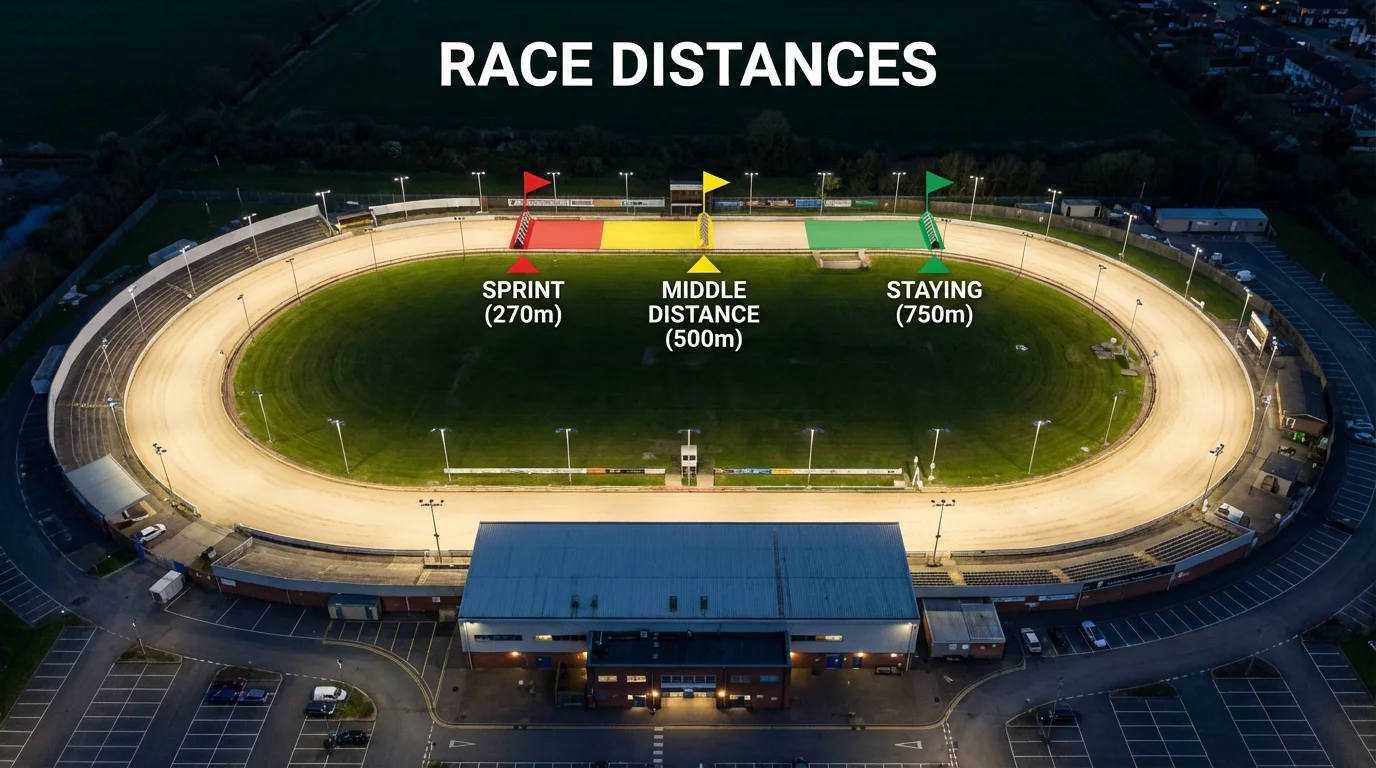
UK greyhound tracks offer a range of distances that fall into distinct categories: sprint, standard middle distance, staying, and marathon. Each category has its own characteristics, its own form dynamics, and its own betting considerations. Beyond the distance categories, the UK calendar also includes specialist race types — hurdles and handicaps — that add further variety. This guide covers what each distance demands from the dogs and from the bettors who back them.
Sprint, Standard, Staying and Marathon Distances
Sprint Races
Sprint distances in UK greyhound racing are typically between 210 and 300 metres, covering two bends and one straight. The entire race lasts roughly 15 to 18 seconds. In that compressed window, there is almost no time for tactical adjustment, recovery from a poor start, or closing from behind. The dog that breaks fastest and reaches the first bend in the lead wins the vast majority of sprint races.
Sprint form is dominated by two factors: trap speed and inside running. A dog with consistently fast splits — the time to the first bend — is the sprinter’s equivalent of a racehorse with a high cruising speed. It is the defining characteristic. Race remarks showing QAw (quick away) in consecutive races are the strongest indicator of sprint ability. Conversely, a dog with SlAw (slow away) remarks has almost no chance of recovering in a sprint. The race is over before the slow starter finds its stride.
For bettors, sprint races are the most predictable distance category in terms of the dominant factor. Early speed is king. Trap draw is highly relevant because inside traps have the shortest path to the first bend. The combination of a fast-starting dog drawn in Trap 1 or 2 at a tight sprint track is one of the more reliable betting propositions in greyhound racing. The limitations are that sprint form is also the most obvious form to read, and the odds tend to reflect the market’s correct assessment of the front-runners — value in sprint betting comes from identifying the less obvious fast starters or the rare closer with genuine sprint pace.
Standard Middle Distance
The standard trip at most UK tracks falls between 400 and 525 metres, covering four bends and two straights. This is where the majority of graded racing takes place, and it produces the deepest competition pools and the most form data for bettors to work with. Middle-distance races last approximately 24 to 30 seconds, long enough for the race to develop a shape beyond the first bend but short enough that early speed remains important.
The middle distance rewards a balance of traits: adequate early speed to avoid first-bend trouble, enough pace to maintain a competitive position through the bends, and sufficient stamina to sustain the effort into the finishing straight. Dogs that lead or sit close to the pace tend to perform best, but strong closers can win if the leaders tire or if the pace is particularly hot. The variety of winning running styles at the standard distance makes form analysis more nuanced than in sprints — you need to assess not just speed but race tactics and running style.
For betting, the standard distance offers the widest range of value opportunities because the form is deepest and the variables are most numerous. Grade promotions and demotions are most active at the standard trip, creating the mis-grades and grade-drop opportunities that informed bettors exploit. The combination of form depth, grading movement, and balanced race dynamics makes the standard distance the core of most serious greyhound bettors’ activity.
Staying Races
Staying distances generally range from 600 to 710 metres, covering six bends and three straights. These races take 36 to 42 seconds — nearly twice the duration of a sprint and significantly longer than the standard trip. The additional distance fundamentally changes what is required. Stamina becomes the dominant trait. Dogs that fade in the final 100 metres of a standard race are exposed over a staying trip, while dogs with exceptional endurance come into their own.
The pool of specialist stayers at any UK track is smaller than the pool of middle-distance runners. This means staying grades are fewer in number (typically S1 to S4), the fields can be more predictable, and the form tends to be more reliable within the grading tier. A dog that consistently places in staying races is likely to continue doing so, because the physical demands of the distance filter out the pretenders more effectively than the standard trip.
Bettors who specialise in staying races often find less competition from the wider market. Casual punters gravitate toward the standard distance, where the action is faster and the meetings more frequent. The staying specialist, by contrast, encounters thinner markets, less-informed odds, and dogs whose form is easier to decode once you understand the unique demands of the distance.
Marathon Distances
Marathon races exceed 800 metres and are relatively rare on the UK calendar. They are the ultimate test of stamina, and only a small number of dogs at any given time have the combination of endurance, pacing ability, and racing intelligence to compete effectively over these distances. Marathon racing is a niche within a niche, and the form data available is correspondingly thin.
For betting purposes, marathon races are speculative territory. The small fields, limited historical form, and unpredictable pacing dynamics make them difficult to assess with confidence. If you encounter a marathon race on a card you are following, treat it as a secondary betting opportunity rather than a primary target — the information asymmetry works against even well-prepared bettors.
Hurdle and Handicap Racing
Hurdle racing adds four flights of low hurdles to a standard or staying distance race. The dogs must jump obstacles while maintaining racing speed, which introduces a skill variable that does not exist in flat racing. Not all greyhounds can hurdle effectively — some refuse, some check their stride, and some lose momentum on landing. The dogs that clear hurdles fluently and maintain their rhythm gain a significant advantage, which means hurdle form is not directly comparable to flat form even over the same distance.
Hurdle races are less commonly offered on UK cards than flat racing, but they appear regularly at certain tracks and can be interesting betting propositions for the prepared bettor. The key form indicator is previous hurdle experience and performance. A dog making its hurdle debut is an unknown quantity regardless of its flat form. A dog with three or four fluent hurdle runs under its belt is a much more reliable assessment.
Handicap racing adjusts the starting position of each dog based on its grade or assessed ability. Faster dogs start behind slower dogs, with staggered trap positions designed to produce a closer finish. Handicap races are relatively uncommon in UK greyhound racing compared to flat graded races, but they do appear at selected meetings. The betting challenge in a handicap is assessing whether the racing manager’s handicap marks accurately reflect the dogs’ abilities — a dog given too generous a head start can represent genuine value.
Matching Distance to Dog Form
The most common mistake in greyhound distance assessment is assuming that form at one distance transfers automatically to another. It does not. A dog with five wins over 480 metres is not guaranteed to stay 660, and a specialist sprinter with exceptional early speed might be a liability over four bends if it lacks the stamina to sustain its pace. Whenever you assess a dog for a race, check whether its recent form is at the same distance as tonight’s race. If the dog is stepping up or down in trip, its existing form is a less reliable guide.
Look for clues in the form that indicate distance suitability. A dog whose race remarks consistently show RnOn (ran on) or Fin (finished well) is a candidate for a step up in distance — it is finding more when the race ends, suggesting it has untapped stamina. A dog whose remarks show Trd (tired) or Fdd (faded) in the final stages of a standard race is not suited to a staying trip and may benefit from a drop to sprints, where the shorter distance prevents it from reaching the point of fatigue.
Breeding can also indicate distance aptitude, though it is a secondary factor. Certain sires are known for producing sprinters, others for producing stayers. This is most useful when assessing a young dog with limited race form — its pedigree may suggest a natural distance range before the race data provides enough evidence. For established dogs with twenty or more races on record, the form itself is a more reliable indicator than the bloodline.
Finding Your Distance — Where Form Meets Specialisation
Just as some bettors specialise in specific tracks, others specialise in specific distances. A punter who focuses exclusively on staying races at three or four tracks will develop a deeper understanding of staying form, staying dogs, and staying trainers than a generalist who bets across all distances. That depth translates into sharper assessments, better odds comparison, and more consistent results.
The distance categories in greyhound racing are not interchangeable modules. Each has its own competitive dynamics, its own form patterns, and its own betting opportunities. Recognising those differences — and choosing which distances align with your analytical strengths — is one of the quieter but more impactful decisions a greyhound bettor can make.