Each Way Greyhound Betting
Best Greyhound Betting Sites – Bet on Greyhounds in 2026
Loading...
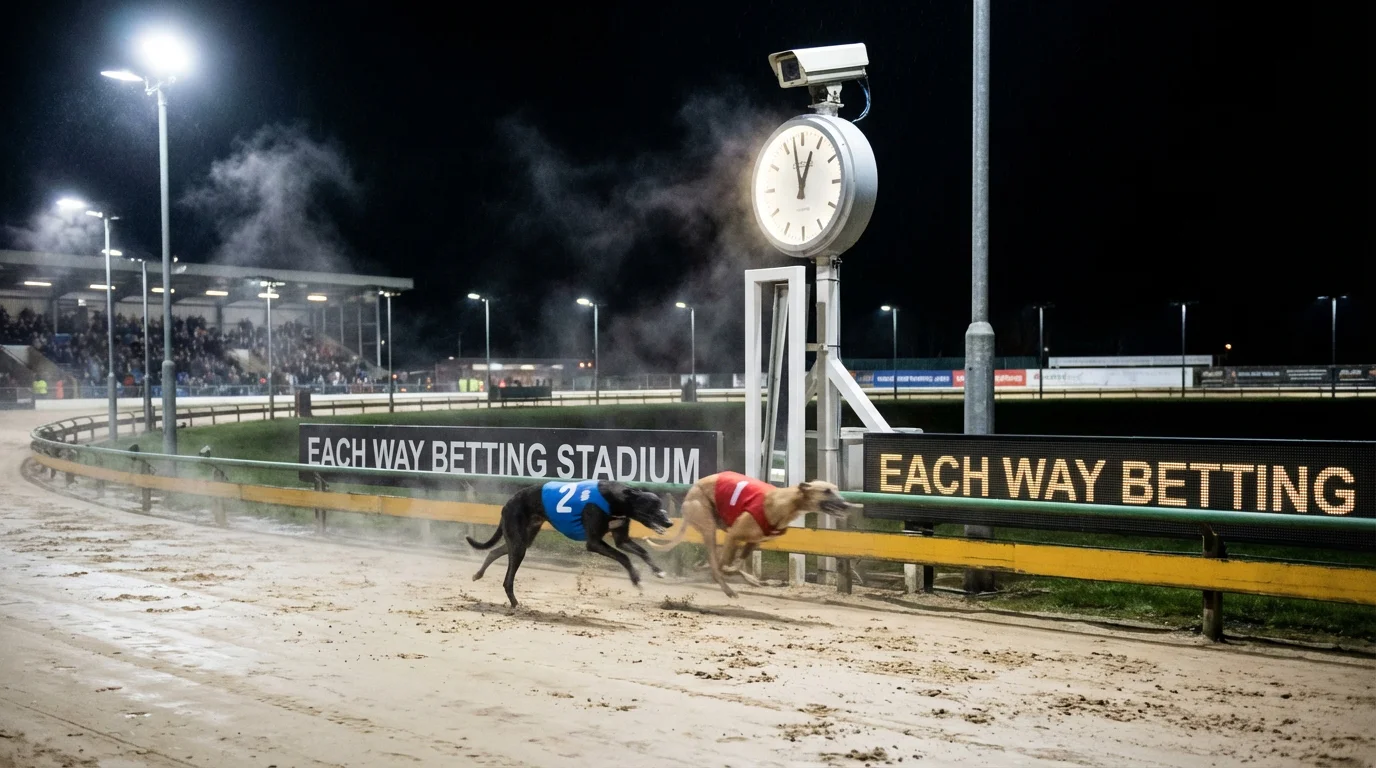
Two Bets in One — Understanding Each Way on the Dogs
Each way betting is the closest thing greyhound racing offers to a built-in hedge. You back a dog to win, and simultaneously you back it to finish in the top two. If it wins, both parts of the bet pay out. If it finishes second, you lose the win part but collect on the place part. If it finishes third or worse, you lose both. It sounds straightforward, and the mechanics are simple, but the strategy underneath is more nuanced than most punters realise.
The each-way bet exists because greyhound racing fields are small and outcomes are volatile. In a six-dog race, even a well-fancied runner can be bumped at the first bend and trail home fourth. The each-way structure gives you a partial return when your dog runs well but does not win — a meaningful consideration in a sport where interference and racing luck play a larger role than in most other betting markets. Knowing when each way offers genuine value, and when it is simply doubling your stake for no meaningful benefit, is one of the foundational skills of profitable greyhound betting.
How Each Way Works in a Six-Dog Field
Place Terms and the Quarter-Odds Rule
In UK greyhound racing, the standard each-way terms for a six-runner race are 1/4 of the odds for two places. This means the place part of your bet is settled at one quarter of the win odds, and it pays if your dog finishes first or second. These terms are consistent across virtually all UK bookmakers for standard greyhound races.
To understand the maths: if you back a dog at 8/1 each way with a one-pound unit stake, your total outlay is two pounds (one pound on the win, one pound on the place). If the dog wins, you collect the win part (8/1 = eight pounds profit plus your one-pound stake back) and the place part (1/4 of 8/1 = 2/1 = two pounds profit plus your one-pound stake back). Total return: twelve pounds on a two-pound stake. If the dog finishes second, you lose the win part (minus one pound) and collect the place part (2/1 = two pounds profit plus one pound stake). Total return: three pounds on a two-pound stake, for a net profit of one pound.
If there are fewer than six runners — which happens occasionally due to non-runners — the place terms may change or place betting may be withdrawn entirely. With five runners, most bookmakers still offer two places at 1/4 odds, but terms can vary. With four or fewer runners, each-way betting is typically unavailable. Always check the specific terms displayed on the bet slip before confirming.
Calculating Your Each Way Returns
The calculation always follows the same logic. Win return equals stake multiplied by odds. Place return equals stake multiplied by (odds divided by 4). Total each-way return when the dog wins is both components combined. When the dog places but does not win, it is the place return only.
At 4/1 each way, one pound: win return is four pounds profit, place return is one pound profit (1/4 of 4/1 = 1/1 = evens). If the dog finishes second, your net position after the two-pound outlay is zero — you break even. This is an important threshold. At odds of 4/1, an each-way bet only makes financial sense on the place component if you believe the dog has a strong chance of winning, because a place finish alone only returns your money.
At 6/1 each way: win return is six pounds profit, place return is 1.50 pounds profit (1/4 of 6/1 = 6/4). A second-place finish nets you 50p after the two-pound stake. Modest, but positive. At 10/1: win return is ten pounds, place return is 2.50 pounds (10/4 = 5/2). A place finish returns 3.50 on a two-pound stake, for a 1.50 profit. Now the each-way structure begins to provide genuine protection.
When Each Way Offers Real Value
The Sweet Spot — Odds of 4/1 to 8/1
Each way betting has a value sweet spot, and in greyhound racing it sits roughly between 4/1 and 8/1. Below 4/1, the place part of the bet returns so little that it barely justifies doubling your stake. Above 8/1, you are typically backing dogs with enough uncertainty about their chances that the each-way structure, while offering a bigger place return, is protecting a bet that may simply not be strong enough.
At short prices — say 6/4 or 2/1 — the place return is negligible. One quarter of 2/1 is 1/2, meaning the place part pays 50p for every pound staked. If your two-pound each-way bet results in a second-place finish, you get back 1.50 on a two-pound outlay, for a net loss of 50p. You have doubled your stake to protect against a 50p loss. That arithmetic does not work. At short odds, a straight win bet is almost always more efficient.
In the 4/1 to 8/1 range, each way starts to make mathematical sense. The place returns are large enough to deliver a meaningful profit on a second-place finish, and the total win return is enhanced enough by the place component to make the doubled stake worthwhile. A 6/1 each way bet that wins pays significantly more than a one-pound win bet at 6/1, because you collect on both components.
At longer odds — 12/1, 16/1, 20/1 — the place part becomes very attractive in isolation. One quarter of 16/1 is 4/1, which is a decent bet in its own right. But the fundamental question is whether you genuinely believe a 16/1 shot will finish in the top two. If your analysis supports it — perhaps the dog has been bumped in recent runs and its form is stronger than the price suggests — then the each-way at a big price can be excellent value. If you are simply hoping for a place because the odds are long, you are speculating rather than betting.
When to Skip Each Way Entirely
There are clear situations where each way is the wrong approach. Backing the favourite each way is almost never a good idea. If a dog is 6/4 to win a six-runner race, the place part is returning next to nothing and you are staking double for minimal protection. If you fancy the favourite, back it to win outright and accept the risk.
Similarly, each way does not make sense on a dog you believe will either win or finish out of the places. Some dogs are all-or-nothing runners: they lead from the front and are hard to pass, or they get caught in traffic and finish nowhere. For these types, the place part of an each-way bet has little practical value because the dog is unlikely to finish second — it either wins or it does not. A straight win bet captures your view more efficiently.
Each way betting works best with consistent placers — dogs whose form shows a string of second and third-place finishes, who reliably run into the frame without necessarily winning. These are the dogs that deliver regular small returns on the place part while occasionally landing the win component for a bigger payday. The form line is your guide: a dog showing 232423 is an each-way bettor’s dream. A dog showing 161516 is not.
Each Way Strategy for Greyhound Bettors
The optimal each-way approach is selective, not habitual. Punters who bet each way on every race because it feels safer are diluting their returns across too many doubled stakes. The smart approach is to identify specific races and specific dogs where the each-way structure adds genuine value.
Look for these characteristics: a dog priced between 4/1 and 8/1 with consistent placing form, drawn in a trap that gives it a clear early run, in a race where the favourite is beatable and the each-way selection could realistically finish first or second. When those conditions align, the each-way bet works exactly as intended — it gives you a profitable return on a place and a substantial return on a win.
One further tactical consideration: each way bets interact with best odds guaranteed. If you take an early price of 5/1 each way and the dog drifts to 8/1 at the off, BOG pays the win part at 8/1 — and the place part is then calculated at one quarter of 8/1, which is 2/1. Both components benefit from the drift. This makes the combination of each way and BOG particularly powerful at bookmakers where both are available on the same race.
Track the performance of your each-way bets separately from your win bets. Over a sample of a hundred or more each-way wagers, you should see the place component delivering consistent small returns that offset some of the losing win bets. If the place component is not pulling its weight — if you are seeing too many third and fourth-place finishes rather than seconds — your selection criteria may need tightening. Each way betting rewards precision. It does not reward volume.
The Place That Pays — Making Each Way Work Long-Term
Each way betting in greyhound racing occupies a specific niche. It is not a catch-all safety net, and it is not a substitute for good selection. It is a bet structure that pays you for being nearly right, and in a six-dog race where racing luck and interference are constant factors, being nearly right has genuine financial value.
The punters who use each way most effectively treat the place part as a bet in its own right, not as an afterthought attached to the win bet. They ask themselves: at one quarter of these odds, is this dog good enough to finish in the first two? If the answer is yes and the price is right, the each-way bet is justified. If the answer is uncertain, a straight win bet at the full odds may be a better use of the money. Discipline in this decision, applied consistently across hundreds of bets, is what separates each-way profit from each-way habit.