
Greyhound Ante Post Betting
Best Greyhound Betting Sites – Bet on Greyhounds in 2026
Loading...
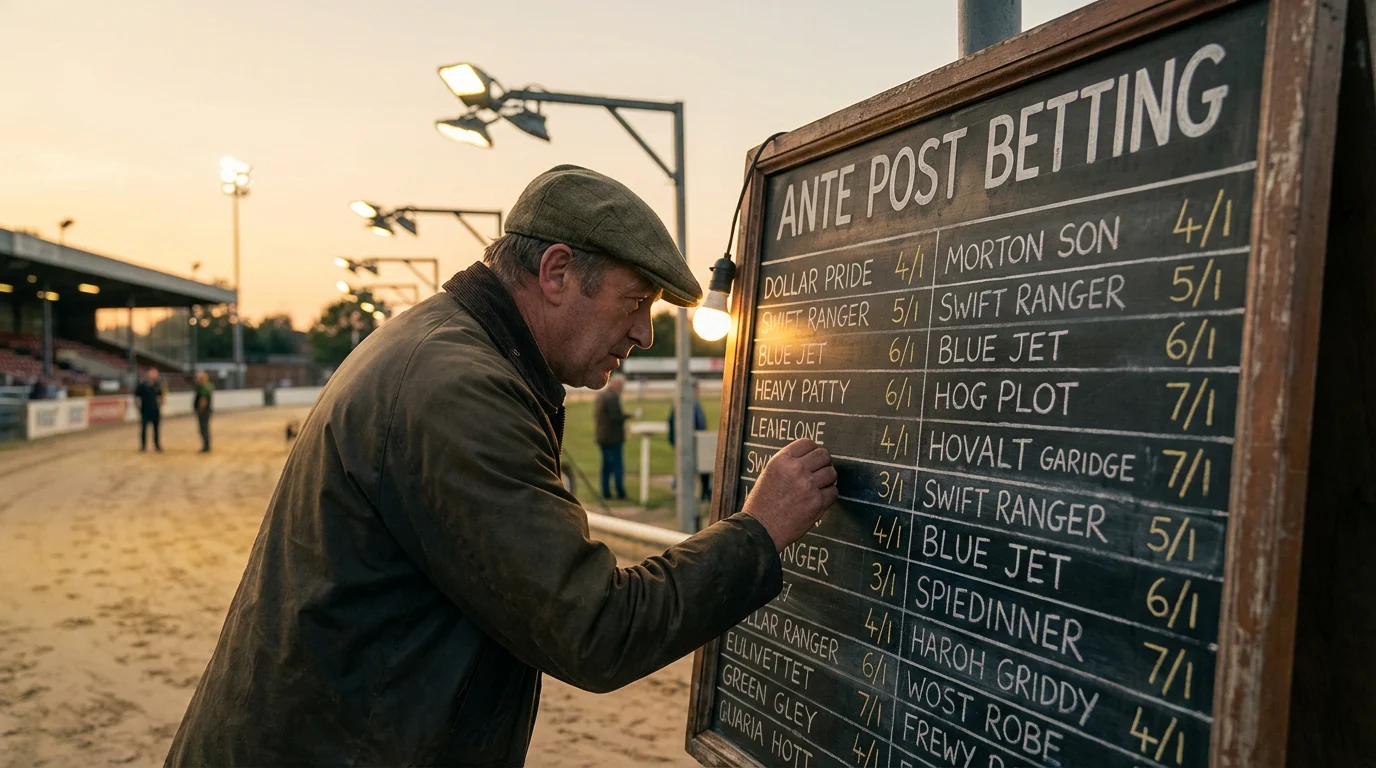
Betting Before the Traps Are Even Built
Ante-post betting is the act of placing a wager on a greyhound event days, weeks, or even months before the competition begins. In most greyhound betting, you back a dog minutes before a single race. Ante-post flips that model entirely. You are betting on an outright outcome — a dog to win a multi-round competition — long before the heats are drawn, before trial times are posted, and before anyone knows which six dogs will contest the final.
The appeal is price. Ante-post odds are almost always significantly larger than the odds available on the same dog once the competition is underway. A dog that opens at 20/1 in the ante-post market for the English Greyhound Derby might be 5/1 by the semi-final stage if it has won its heats convincingly. The bettor who took 20/1 six weeks earlier holds a position that cannot be replicated at any later point. That is the trade: you accept uncertainty and risk in exchange for a price the market will never offer again.
Ante-post greyhound betting is a niche within a niche. It is available only on major competitions — the sport’s showpiece events — and the markets are thinner, the information sparser, and the risks more pronounced than in standard race-day betting. But for the punter willing to do the homework, ante-post markets offer some of the most genuine value opportunities in the entire sport.
How Ante-Post Greyhound Markets Work
Ante-post markets for greyhound competitions open weeks or months before the event. Bookmakers price up a list of likely contenders — typically the leading open-race dogs in training at the time — and set initial odds based on recent form, trainer reputation, and historical performance at the host track. These early prices are speculative by nature, because the bookmaker is pricing an uncertain future, and that speculation creates wider margins of error that an informed bettor can exploit.
As the competition approaches and more information becomes available — trial times at the host track, heat draws, early-round results — the market adjusts. Dogs that perform well in trials shorten. Dogs that suffer setbacks drift or are removed from the market entirely. The ante-post price you took at the opening of the market is locked in, regardless of how the odds move subsequently.
The critical distinction from standard race-day betting is that ante-post bets are typically “all in, run or not.” If your dog is withdrawn from the competition for any reason — injury, illness, failure to qualify through the heats — your stake is lost. There is no refund. This is the primary risk of ante-post betting and the reason the prices are so generous. The bookmaker is compensating you for the possibility that your selection never reaches the final.
Some bookmakers offer “non-runner, no bet” terms on selected ante-post markets, which refund your stake if the dog does not participate. These terms are less common in greyhound racing than in horse racing, and when they are offered, the odds are shorter to account for the reduced risk. If non-runner-no-bet terms are available and the price differential is modest, they are almost always worth taking — the protection against withdrawal is more valuable than the extra point or two of odds you sacrifice.
Major Ante-Post Events
The English Greyhound Derby
The Derby is the pinnacle of UK greyhound racing and the marquee ante-post betting event of the calendar. Held annually, the competition draws the best open-class dogs from across the UK and Ireland. The ante-post market typically opens several months before the first heats, with initial fields of 30 to 50 priced dogs. The competition runs through multiple rounds — first-round heats, second-round heats, quarter-finals, semi-finals, and the six-dog final — which means a dog must win or qualify through several races to reach the title race.
Derby ante-post betting rewards early identification of quality. Dogs that have shown exceptional form in open races during the spring, particularly at the host track, tend to shorten rapidly once the market engages. If you can identify a talented dog before the wider market has recognised its Derby credentials — perhaps a rapidly improving youngster or a dog returning from a break with strong trial times — the ante-post price can be several multiples of the eventual starting price in the final.
The St Leger and the Oaks
The St Leger is the sport’s premier staying event, contested over a longer distance than the Derby. It attracts specialist stayers and dogs with the stamina to sustain their pace over the extended trip. The ante-post market for the St Leger is smaller than the Derby but can offer excellent value because the pool of genuine stayers is narrower, making it easier to identify contenders if you follow staying-race form throughout the season.
The Oaks is the leading competition for female greyhounds, run over the standard distance. The ante-post market follows the same structure as the Derby — heats through to a six-dog final — but with a restricted entry of bitches only. Oaks form can be more predictable than open Derby form because the female greyhound population is smaller, and the top bitches tend to be well known to followers of the sport.
Beyond these three flagship events, ante-post markets are occasionally available for other Category 1 competitions and for major open races at individual tracks. Availability varies by bookmaker, and the markets tend to be shorter-lived and less liquid than the Derby ante-post book.
Ante-Post Strategy — Managing the All-In Risk
The all-in rule is the defining risk of ante-post greyhound betting, and managing it is the core of any sensible ante-post strategy. You can mitigate it, but you cannot eliminate it. The goal is to ensure that the prices you take are large enough to compensate for the inevitable withdrawals, and that your selection process is rigorous enough to minimise the frequency of backing dogs that never reach the final.
Start with the dog’s health and racing history. Dogs with a clean injury record and consistent racing schedule are lower withdrawal risks than dogs returning from layoffs or those with known physical vulnerabilities. Trainer interviews, where available, can provide clues about a dog’s wellbeing and preparation — though these should be treated with appropriate scepticism, as trainers have obvious incentives to talk up their runners.
Trial performance at the host track is the single most valuable data point for ante-post assessment. A dog that posts a quick, fluent trial at the competition venue is demonstrating that it handles the track — which eliminates one of the major unknowns in ante-post betting. If you can wait for trial results before placing your ante-post bet, you reduce your risk significantly, though you may sacrifice some of the earliest and largest odds.
Diversification helps. Rather than placing one large ante-post bet on a single dog, consider splitting your stake across two or three contenders at different prices. If one withdraws and one reaches the final, the surviving bet at a large ante-post price can more than cover the lost stake on the withdrawn dog. This is not a guaranteed approach — all three could withdraw — but it spreads the all-in risk across multiple selections.
The most common ante-post mistake is backing too many dogs at short prices. If you take 4/1 ante-post on a Derby favourite that subsequently withdraws, you have lost your stake on a price that did not adequately compensate for the withdrawal risk. Ante-post betting only makes mathematical sense when the odds are significantly larger than the expected race-day price. A good rule of thumb: if you would not be satisfied with the ante-post price as a race-day price, it is not worth the additional risk.
The Long Game — Why Ante-Post Rewards Patience
Ante-post greyhound betting is not for the impatient or the faint-hearted. You place your bet and then wait — through weeks of trials, heats, and qualifying rounds — before you know whether your selection has even reached the final. The emotional discipline required is different from backing a dog in a race that starts in three minutes. You cannot watch your bet resolve in thirty seconds. You have to sit with it.
But the rewards justify the wait. The ante-post market is the least efficient market in greyhound betting. Fewer punters participate, the information is sparser, and the bookmakers’ prices reflect uncertainty rather than precision. These are the conditions that create value for bettors who do their homework. A well-researched ante-post bet at 16/1 on a dog that starts the final at 3/1 is not luck — it is the product of identifying quality before the crowd, accepting the risk, and being right.
Treat ante-post as a separate discipline within your greyhound betting, with its own bankroll allocation, its own selection criteria, and its own expectations. The strike rate will be lower than race-day betting. The losing runs will be longer. But the individual payouts, when they arrive, can transform a season’s results in a single race.