Greyhound Exchange Betting
Best Greyhound Betting Sites – Bet on Greyhounds in 2026
Loading...
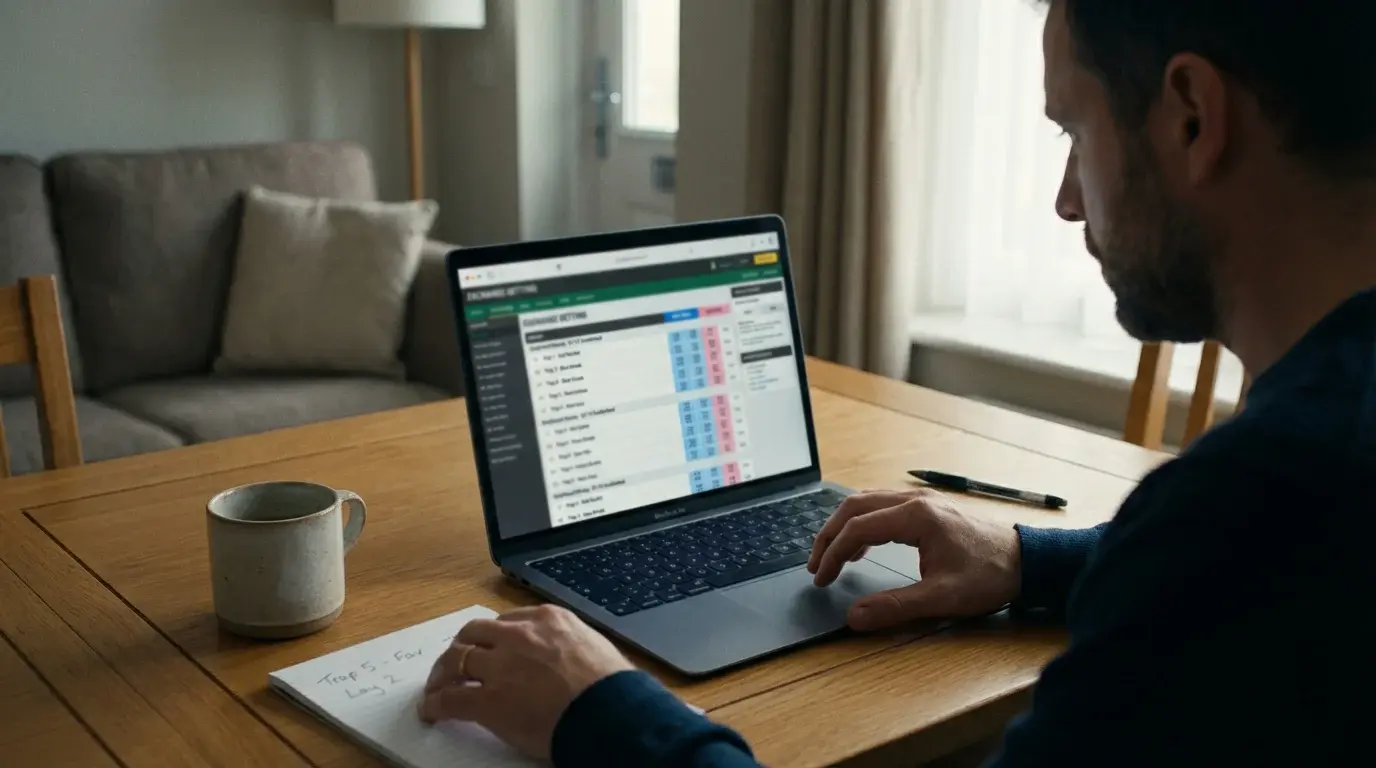
Backing, Laying and Trading — A Different Kind of Greyhound Market
A betting exchange is not a bookmaker. It is a platform where bettors trade odds with each other, and that structural difference changes virtually everything about how greyhound betting works. On an exchange, you can back a dog to win — just as you would at a traditional bookmaker — but you can also lay a dog, which means betting against it. You can trade positions before the race starts, locking in a profit or cutting a loss by adjusting your exposure as the odds move. The exchange charges a commission on winning bets rather than building a margin into the odds, and because of that, exchange odds on greyhound races are frequently better than those available at fixed-odds bookmakers.
Betfair is the dominant exchange in the UK market and the only platform with meaningful liquidity on greyhound racing. Smarkets and Betdaq offer exchange markets on some greyhound meetings, but the volume of money matched on those platforms is typically too thin to be practical for anything beyond small stakes. For the purposes of this guide, exchange betting on greyhounds effectively means Betfair.
Back and Lay — The Two Sides of the Exchange
Backing on the Exchange
A back bet on an exchange is identical in outcome to a back bet at a bookmaker: you are betting that a dog will win. The difference is in the odds and the cost structure. Exchange back odds are set by other users of the platform rather than by a bookmaker’s traders, and because there is no bookmaker margin embedded in the price, exchange odds are typically 5 to 20 percent higher than the equivalent fixed-odds price. A dog available at 3/1 with a bookmaker might be 7/2 or even 4/1 on the exchange.
The catch is commission. Betfair charges a percentage of your net winnings — the standard rate is 5 percent, though this can be reduced for high-volume users. On a winning back bet at 4/1 with a ten-pound stake, your gross profit is forty pounds, and Betfair takes two pounds in commission, leaving you with thirty-eight pounds net. This is still better than the 3/1 the bookmaker offered, which would have returned thirty pounds. The exchange wins on price even after commission in most cases, though the advantage narrows at shorter odds where the bookmaker’s margin is smallest.
Laying on the Exchange
The lay bet is what makes the exchange genuinely different. When you lay a dog, you are betting that it will not win. You take the role of the bookmaker: if the dog loses, you keep the backer’s stake. If the dog wins, you pay out the winnings. Your liability — the amount you stand to lose if the dog wins — is calculated as the lay odds minus one, multiplied by the backer’s stake.
For example, you lay Dog A at 4/1 for ten pounds. If Dog A loses, you win ten pounds (minus commission). If Dog A wins, you pay out thirty pounds (the 4/1 price minus the stake component, times ten). The asymmetry is obvious: you risk thirty to win ten. But the probability is in your favour — a 4/1 shot wins approximately 20 percent of the time, which means it loses 80 percent of the time. Laying at fair odds is a break-even proposition before commission. Laying at odds that are too high — where the dog’s true chance of winning is less than the implied probability of the lay price — is where profit comes from.
Laying is particularly interesting in greyhound racing because of the sport’s inherent unpredictability. In a six-dog race, even the favourite loses more often than it wins. A 5/4 favourite has an implied probability of about 44 percent, which means it loses 56 percent of the time. If you can identify races where the favourite is overrated — perhaps drawn badly, facing an improving rival, or coming off a flattering form line — laying it at 5/4 on the exchange can be a profitable long-term strategy, despite the individual-race risk of a large payout.
Liquidity — The Exchange’s Achilles Heel for Greyhound Bettors
Liquidity is the amount of money available to be matched at any given price on the exchange. In horse racing, Betfair markets for major meetings carry tens of thousands of pounds in available bets at multiple price points. In greyhound racing, the picture is very different. Greyhound markets are thin. A typical graded race at an afternoon BAGS meeting might have a few hundred pounds matched across the entire market. Evening cards at major tracks generate more volume, but even the busiest greyhound exchange markets rarely approach the liquidity levels of mid-tier horse racing.
Low liquidity creates several practical problems. You may not be able to get matched at the price you want, because there is not enough money on the other side. Large stakes can move the market — placing a hundred-pound bet at 4/1 on a greyhound might clear all the available money at that price and push the odds down to 7/2, where only part of your remaining stake is matched. And in pre-race trading, the spread between the back and lay prices can be wide, making it difficult to trade in and out of positions profitably.
The liquidity constraint means exchange betting on greyhounds is best suited to modest stakes. If you are betting five to twenty pounds per race, you will usually find enough liquidity to get matched at or near the displayed price. Above fifty pounds, you may experience partial matching and slippage. For very large stakes, the traditional bookmaker market offers better execution despite the inferior odds.
In-play exchange betting on greyhounds is virtually non-existent. The races are too short — thirty seconds or less — for meaningful in-play trading, and the live markets carry almost no liquidity. If you want to trade greyhound positions, you need to do it pre-race.
When the Exchange Beats Fixed Odds
Despite the liquidity challenges, there are specific scenarios where exchange betting consistently offers better value than fixed-odds bookmakers for greyhound punters.
The clearest advantage is on back bets at longer odds. A dog priced at 8/1 with a bookmaker might be 10/1 or 12/1 on the exchange. The bookmaker’s margin is widest on outsiders, because the probability of any single long-priced dog winning is low and the bookmaker can shade the price without most punters noticing. The exchange, by contrast, prices according to supply and demand, and long-priced dogs often trade at significantly better odds. After the 5 percent commission, a winning bet at 10/1 on the exchange returns 9.5/1 net — still considerably better than the bookmaker’s 8/1.
Laying favourites is an opportunity that bookmakers simply do not offer. If your analysis tells you a race favourite at 6/4 is overpriced — it should be closer to evens based on your assessment — you cannot express that view at a bookmaker. On the exchange, you lay it at 6/4 and profit every time it loses. This is not a magic formula — favourites still win regularly — but it is a market that rewards the bettor who can identify when a favourite’s price does not reflect its true chance.
The exchange also excels when you want to back a dog early and then lock in a profit if the price shortens. If you back a dog at 6/1 on the exchange and the price contracts to 3/1 before the race, you can lay it at 3/1 for a proportionate stake, guaranteeing a profit regardless of the result. This trading approach requires pre-race price movement and sufficient liquidity to execute the lay, both of which are more available on evening meetings at major tracks than on quiet afternoon cards.
The Exchange Mindset — A Tool, Not a Replacement
Exchange betting is not a wholesale replacement for fixed-odds bookmaker betting on greyhounds. The liquidity constraints are too significant for it to serve as your only platform. But as a supplementary tool — one more weapon in the bettor’s arsenal — the exchange offers genuine advantages that no bookmaker can replicate.
Use the exchange for lay bets when you have a strong opinion against a specific dog. Use it for back bets at longer odds where the price advantage over bookmakers is largest. Use it for pre-race trading when conditions allow. And use bookmakers for everything else — short-priced backs, each-way bets, forecasts, tricasts, and any situation where you need BOG protection or reliable stake execution. The two platforms are complementary, and the bettor who uses both according to their strengths is better positioned than the one who relies exclusively on either.