Greyhound Forecast Betting
Best Greyhound Betting Sites – Bet on Greyhounds in 2026
Loading...
Calling First and Second — The Art of the Forecast
The win bet asks one question. The forecast asks two. You are no longer just picking the dog that crosses the line first — you are predicting who finishes second as well. In a six-dog field, that second question multiplies the difficulty, but it also multiplies the potential return. Forecast bets are where greyhound betting begins to reward genuine race analysis rather than gut feeling, because identifying the likely runner-up requires you to think about how an entire race unfolds, not just who has the fastest legs.
For punters who have mastered the basic win and each-way markets, forecasts represent a natural step up in both complexity and reward. The payouts can be substantial — a correctly predicted 1-2 finish in a competitive race routinely returns multiples of what a straight win bet on the favourite would have paid. The trade-off is lower strike rates. You need both selections to land in the correct positions, which means your analysis has to be sharper and your tolerance for losing runs higher. That said, in a sport where six-dog fields mean fewer variables than a twenty-runner horse race, forecasts in greyhound racing are more achievable than in most other betting disciplines.
Types of Forecast Bet in Greyhound Racing
Straight Forecast — Exact Order
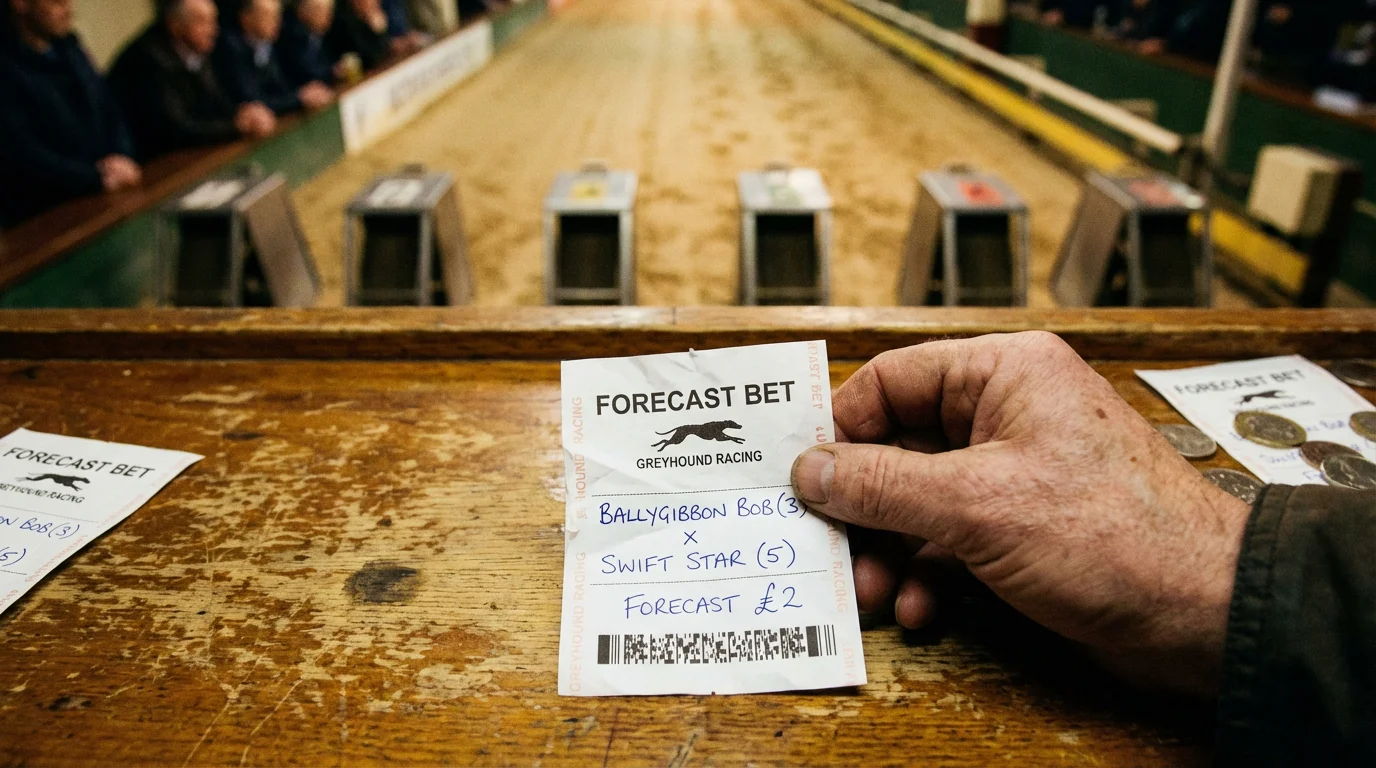
Straight means exact. The straight forecast requires you to name the first and second finishers in the precise order they cross the line. Pick dog A to win and dog B to finish second. If A wins and B is second, you collect. Any other combination — B first and A second, A first and C second, or anything else — and the bet loses.
The payout for a straight forecast is determined by the computer straight forecast dividend, commonly abbreviated to CSF. This is not a fixed odds price that you take before the race. Instead, the CSF is calculated after the race based on the starting prices of the first two finishers. The formula factors in the odds of both dogs and the overall market structure. In practical terms, this means you do not know your exact return until the race is over. What you do know is that CSF dividends tend to be generous — often exceeding what you would get from taking the fixed odds on the winner alone, because you have demonstrated precision rather than simply backing a winner.
Straight forecasts are most attractive in races where you have a strong opinion about both the winner and the runner-up. If you are confident that the Trap 1 dog will lead from the first bend and the Trap 5 dog has the pace to run into second but not challenge for the win, a straight forecast turns that analysis into a high-value bet.
Reverse Forecast — Either Order
A reverse forecast covers the same two dogs but in either finishing order. If you select dogs A and B, you win whether A finishes first and B second, or B finishes first and A second. The flexibility comes at a cost: a reverse forecast is two bets (A-B and B-A), so your stake is doubled. If you place a one-pound reverse forecast, your total outlay is two pounds.
The payout for a reverse forecast is the CSF dividend for the actual finishing order. If A beats B, you are paid the CSF for A first and B second. The other half of your reverse forecast — B first and A second — loses. Your return is the CSF minus the total two-unit stake.
Reverse forecasts make sense when you are confident that two dogs will fill the first two places but less certain about the exact order. This happens frequently in greyhound racing, particularly in races where two dogs have clearly superior form to the rest of the field. Rather than agonising over which one will edge it, the reverse forecast lets you back your assessment of the top-two pair and profit regardless of which prevails.
Combination Forecast — Multiple Selections
A combination forecast extends the logic further. Instead of selecting two dogs, you choose three or more, and the bet covers every possible first-and-second permutation among your selections. The formula for calculating the number of bets is straightforward: n multiplied by (n minus 1), where n is the number of dogs you select.
Select three dogs and your combination forecast contains six bets (3 x 2). Select four and it contains twelve bets (4 x 3). The stake per bet multiplied by the number of bets gives your total outlay. A one-pound combination forecast on three dogs costs six pounds. On four dogs, twelve pounds. The cost escalates quickly, which means combination forecasts need to be used selectively — ideally in races where you have strong opinions about three or four dogs and the likely CSF dividends are large enough to justify the stake commitment.
The advantage of a combination forecast is coverage. You are essentially saying: I believe the first two places will come from this group of dogs, and I want to profit no matter which pair and which order they finish in. The disadvantage is dilution. If the favourite wins and the second favourite runs into second, the CSF dividend may not cover the cost of all those losing permutations. Combination forecasts pay best when at least one of the first two finishers is at a decent price.
How Forecast Payouts Are Calculated
Forecast dividends are not set until the dogs cross the line. This is one of the most important things to understand about forecast betting, because it means you cannot calculate your exact return before the race.
The computer straight forecast dividend is generated by a formula that uses the starting prices of the first and second finishers. The calculation accounts for the odds of both dogs and applies a mathematical model to determine a fair payout. Without going deep into the algebra, the key principle is this: the bigger the prices of both finishers, the larger the CSF. A 1-2 finish by the first and second favourites will produce a modest CSF — perhaps ten to twenty times your stake. A 1-2 involving a 6/1 winner and a 10/1 runner-up will produce a significantly larger dividend, potentially fifty to one hundred times your stake or more.
Some bookmakers also offer fixed-odds forecasts, where you can see the price before the race and lock it in. Fixed-odds forecasts are convenient because you know exactly what you will win, but they almost always pay less than the equivalent CSF. The bookmaker builds in a larger margin on fixed-odds forecasts because they are assuming the risk of the payout. With the CSF, the payout is determined by the market, and the market tends to be more generous.
In practice, most experienced greyhound bettors prefer CSF forecasts over fixed odds. The trade-off of not knowing the exact return is more than compensated by the consistently higher dividends. The exception is when a bookmaker offers an enhanced fixed-odds forecast on a promoted race — in those cases, the fixed odds can occasionally exceed the likely CSF, and the known return becomes the better option.
To estimate likely CSF returns before a race, you can use the early market prices as a guide. If both your forecast selections are showing around 3/1 to 4/1, expect a CSF in the range of 20/1 to 40/1. If one is a short-priced favourite at evens and the other is a 5/1 shot, the CSF will be lower, typically 10/1 to 20/1. These are rough approximations — the actual CSF depends on the full market at the off, not just the prices of the first two finishers — but they give you enough information to decide whether the forecast is worth the stake.
When to Use Forecast Bets — And When Not To
Finding the winner is one skill. Finding the second dog is another entirely. The best forecast races are those where the likely shape of the race is predictable — where you can visualise how the first bend will play out, who will lead, who will chase, and who will be fighting for minor places.
Strong forecast situations include graded races where one dog has clearly superior recent form and another has been consistently running into second or third. If the form suggests a particular dog will lead and a particular rival will chase it home, a straight forecast captures that view at attractive odds. Races where the top two are separated from the rest of the field by form and class are ideal.
Weak forecast situations include open races with six closely matched runners, where any four dogs could realistically finish in the top two. In these races, the number of plausible 1-2 combinations is too high for a straight or reverse forecast to be efficient. You would need a combination forecast covering four or five dogs, and the cost of that many permutations often erodes the profit potential.
Trap draw analysis is particularly valuable for forecast betting. If you know that Trap 1 is a confirmed railer with fast early speed and Trap 6 is a wide runner with strong late pace, you can build a forecast around the race pattern: Trap 1 leads, Trap 6 closes into second. The dogs in Traps 2 through 5, running in the pack, may have equal raw ability but are more likely to encounter interference. The forecast rewards you for understanding not just who is fastest, but who gets the cleanest run.
The art of identifying the second-place dog is what separates forecast bettors from casual punters. Most people can identify the likely winner of a race. Far fewer think critically about who will fill the places. It requires reading the racecard for running style, trap position, early speed, and finishing effort — the same skills used for win betting, applied with more precision. Once you develop an eye for the likely race shape, forecasts become one of the most rewarding markets in greyhound racing.
The Order of Things — Making Forecasts Work For You
Once you start thinking about the order, you never look at a race the same way. The forecast forces you to move beyond the binary question of who wins and into a much richer analysis of how the race plays out. Who breaks fastest? Who gets to the first bend in front? Who closes from behind? Where does the interference happen? These are the questions that forecast betting demands, and they are the same questions that improve every other aspect of your greyhound betting.
Forecasts are not for every race, and they are not for every punter. The strike rate is lower than win betting, the losing runs are longer, and the temptation to chase a big CSF payout can lead to over-staking. The discipline required is real. But for the bettor who has done their homework on form, trap draws, and race dynamics, the forecast is where the racecard reading translates into meaningful returns.
Start with straight forecasts in races where you have strong convictions about both the winner and the runner-up. Graduate to reverse forecasts when you are confident in the top two but uncertain about the order. Use combination forecasts sparingly, only in races where the likely CSF justifies the stake outlay. And always remember that the CSF dividend is your friend — the post-race calculation almost always treats you better than fixed odds, and over time, that difference compounds into a genuine edge.