Greyhound Grading System Explained
Best Greyhound Betting Sites – Bet on Greyhounds in 2026
Loading...
Grades Are the Backbone of Greyhound Racing
Every greyhound race you see on a UK racecard has been assembled by a racing manager whose entire job is matching dogs of similar ability against each other. The tool they use is the grading system, and it governs everything from which six dogs line up in a Tuesday afternoon race at Romford to which runners contest an A1 final at Hove on a Saturday night. Ignore it and you are betting on aesthetics. Understand it and you have a structural framework for every wager you place.
The system works differently from horse racing, where weights and handicap marks adjust the playing field. In greyhound racing, the field is levelled before the traps open. Dogs are grouped by their recorded times over specific distances at specific tracks, then slotted into grades that aim to produce competitive, closely fought races. The principle is simple: a dog running 28.60 seconds over 480 metres should not be lining up against a dog running 29.80 over the same trip. The grading system keeps them apart.
For bettors, this matters in direct, practical terms. A dog’s grade tells you the standard of opposition it faces, which informs the odds, shapes your form analysis, and ultimately determines whether the price on offer represents any value. A consistent A4 performer dropping into an A5 race is a very different proposition from an A7 dog promoted after a single win. The grading system is the context that makes form figures readable.
All graded racing at GBGB-registered tracks in the UK falls under this structure. There are currently 18 licensed racecourses operating under the Greyhound Board of Great Britain (source: GBGB Racecourses), and each one runs its own internal grading ladder, managed by its own racing office. The grades are local, not national, which adds a layer of complexity that most casual punters overlook entirely.
How Greyhound Grades Work — A1 to A11
Grade Letters and Distance Categories
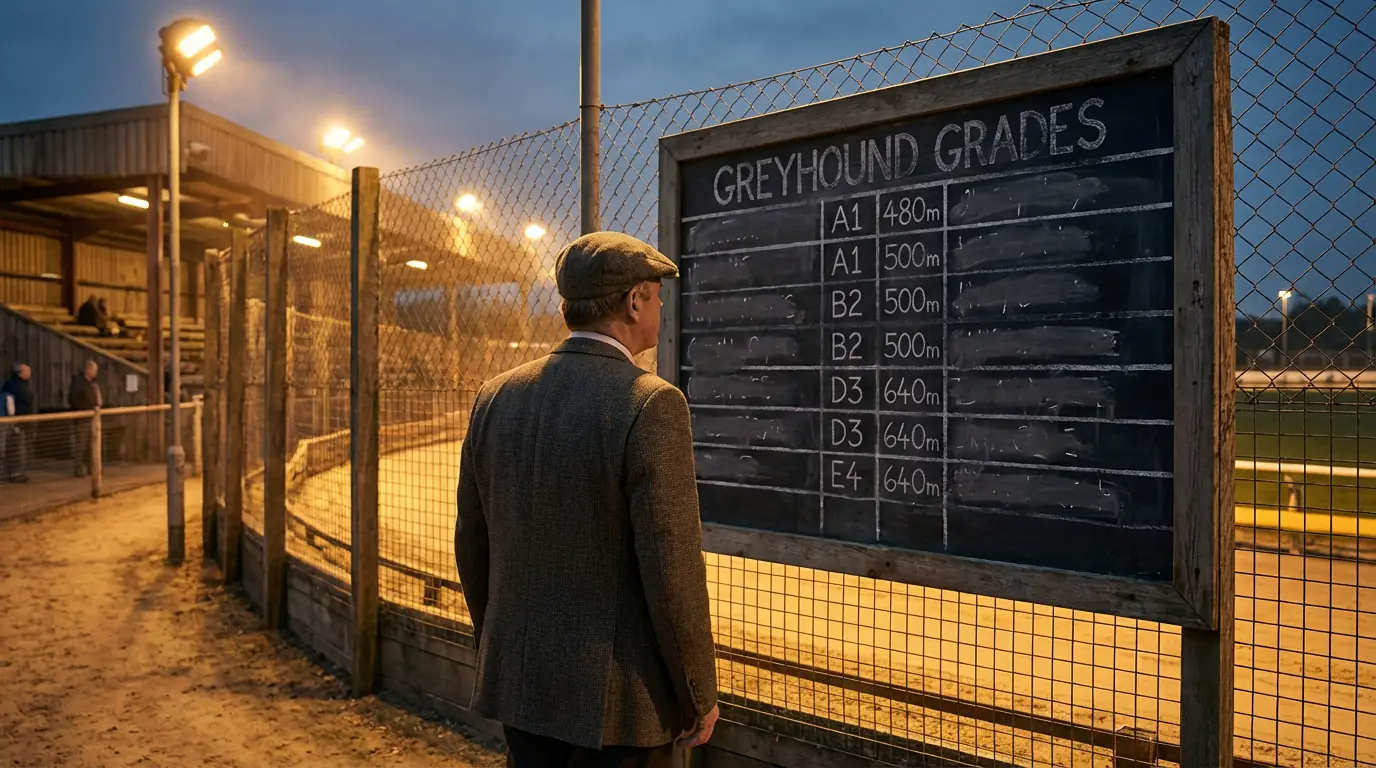
The first thing to understand is that greyhound grades have two components: a letter and a number. The letter designates the distance category. The number designates the ability level within that category.
The standard distance categories in UK greyhound racing are as follows. “A” covers middle-distance races, which is the standard trip at most tracks, typically between 450 and 525 metres. This is where the majority of graded racing takes place and where the deepest grading ladders exist. “D” designates sprint races, usually under 300 metres. “S” marks stayers’ races, generally between 600 and 700 metres. “E” covers marathon distances, anything over 800 metres. Two additional prefixes you will see on racecards are “P” for puppy races, restricted to dogs under 24 months, and “V” for veteran races, aimed at older dogs typically over four years of age.
Each track offers different distances depending on its circumference and layout. Romford, with its tight bends and short straights, runs standard middle-distance races over 400 metres. Nottingham, a larger circuit, uses 480 metres as its standard trip. The “A” grade at Romford and the “A” grade at Nottingham refer to different physical distances, but both represent the standard middle-distance category at their respective tracks. This is why greyhound grades are fundamentally local.
Grade Numbers and Ability Levels
The number attached to each grade letter reflects the dog’s speed and ability relative to other runners at that track and distance. Grade 1 is the highest, reserved for the fastest dogs. The numbers increase downward from there, with the lowest typically being A11 at tracks with enough runners to support that many divisions.
In practical terms, the speed benchmarks look roughly like this at a standard-distance track. Dogs in grades A1 to A3 are the elite — averaging speeds around 38 to 39 miles per hour, posting the quickest calculated times over their track’s standard distance. Grades A4 to A6 represent solid, competitive middle-tier runners, averaging around 37 to 38 mph. Grades A7 to A11 include dogs that are either beginning their careers, winding down toward retirement, or simply not as fast. Their average speeds fall in the 35 to 37 mph range.
Sprint grades (D1 to D6) and staying grades (S1 to S6) follow the same numerical logic but tend to have fewer divisions because the pool of specialist sprinters and stayers at any given track is smaller than the pool of middle-distance runners. Some tracks only operate three or four sprint grades and a similar number of staying grades.
One point that catches out novice bettors: an A1 dog at Crayford is not necessarily the same quality as an A1 dog at Hove. Each track’s grading ladder reflects its own population of runners. A top-graded dog at a smaller, less competitive venue might struggle at a bigger track with deeper talent. This is why direct comparison between tracks requires caution, and why open races — where dogs from different tracks compete against each other — represent such a significant step up in class.
How Dogs Move Between Grades
Greyhound grades are not fixed. They move, and the direction of that movement is one of the most useful signals available to bettors.
The basic mechanism is straightforward. A dog that wins a race, particularly with a fast time, is a candidate for promotion to a higher grade. A dog that finishes consistently outside the top three, or posts slower times than its grade peers, is likely to be dropped. The racing manager at each track has discretion over these adjustments, and the decisions are based on times, results, and the overall balance of the grading card rather than on any rigid formula.
Promotion does not happen automatically after a single win. A dog might win an A6 race in a moderate time against weak opposition and remain in A6. Conversely, a dog that runs a close second with a fast time might be bumped up even without winning. The racing manager is reading the same data you are — times, margins, running style — and making a judgment about where the dog fits competitively.
For bettors, the key patterns to watch are these. A dog that has been promoted after consecutive wins is likely meeting stiffer opposition and may find the new grade more challenging. This is the classic “promoted too fast” scenario, and it often leads to inflated odds that do not reflect the true ability gap. On the other hand, a dog that has been relegated after a rough run of results may be underestimated in its new, lower grade. If the poor results were caused by bad luck — bumping, crowding, unfavourable trap draws — rather than a genuine decline in form, the relegation creates a potential value opportunity.
Young dogs under 30 months are the most volatile movers. They can climb three or four grades in the space of a couple of months as they mature physically and learn to race. Following an improving young dog through grade promotions is one of the more reliable angles in greyhound betting, provided you act before the market catches up. Veterans, by contrast, tend to slide gradually down the grades. Their decline is usually in pace rather than in racing intelligence, which means they can still compete at lower levels for extended periods.
Grade history is available on most racing data sites and within the racecard information provided by bookmakers. Checking a dog’s grade trajectory over its last ten to fifteen runs gives you a far more complete picture than a single current grade number ever could.
Open Races — Where Grades Don’t Apply
Above the grading ladder sits a separate tier of competition: open races. These are not graded in the conventional sense. Instead, they are classified by category, with Category 1 representing the highest level of the sport — events like the English Greyhound Derby, the Greyhound St Leger, and the Greyhound Oaks.
Open races draw the best dogs from multiple tracks, and that changes the entire betting proposition. In a graded race, you are comparing dogs that have been running at the same track, over the same distance, against broadly similar opposition. The form is local, the data is consistent, and the grading system has done most of the sorting work for you. In an open race, dogs arrive from different tracks with different circumferences, different sand conditions, and different grading standards. A dog that dominated A1 races at Sunderland may not replicate that form at Towcester’s longer, wider circuit.
The prize money jump is substantial. Graded race prize funds at most tracks range from a few hundred pounds to perhaps a thousand for top-grade finals. Open race prize money starts significantly higher, and for Category 1 events the numbers become genuinely large. The 2025 English Greyhound Derby at Towcester carried a winner’s prize of 175,000 pounds, with total prize money of 235,000 pounds across the final (source: GBGB).
For betting purposes, open races require a different analytical approach. You need to assess how a dog’s home-track form translates to the open race venue. Trial times at the host track, where available, are often more informative than graded form at the dog’s home venue. Trainer records at specific tracks become relevant. And because the fields contain fewer known quantities, the ante-post markets for major open races can offer genuine value — particularly if you identify a dog whose form at its home track is stronger than its open race odds suggest.
The step from top graded racing to open racing is the largest competitive jump in the sport. Many dogs that look untouchable in A1 graded company struggle to hold their own against genuine open-class runners. Recognising which dogs have the raw ability and the racing temperament to make that transition is one of the more rewarding challenges for serious greyhound bettors.
Grading the Grader — Using the System to Your Advantage
The grading system is designed to be fair, and broadly speaking it achieves that goal. But it operates on limited data — trial times, recent race results, racing manager judgment — and limited data means imperfect outcomes. Dogs get mis-graded. It happens regularly, and it creates opportunities.
The most common mis-grade scenario involves a dog that has been assessed on a small number of trials, particularly after arriving at a new track. Two trials over an unfamiliar distance on unfamiliar sand can produce times that do not reflect the dog’s true ability. If those trials were run on a heavy track after rain, or if the dog was unsettled by new surroundings, the initial grade may be too low. A dog graded A7 on the basis of slow trials that then wins its first race by six lengths is not a surprise to anyone who watched those trials critically — but it may pay handsomely at the bookmaker.
The opposite happens too. A dog that posts a quick trial in ideal conditions might be graded higher than its ability warrants, leading to a string of disappointing results at the new grade. This is less useful from a betting perspective — backing dogs that cannot compete at their grade is a losing proposition — but it is useful for identifying which dogs in a race are likely to fade and therefore which rivals might benefit.
Another angle is the grade-drop-after-absence pattern. A dog returning from injury or a spell away from the track may be dropped a grade as a precaution, even if the underlying ability has not diminished. If the absence was for a minor issue and the dog has had adequate trials on return, the lower grade can represent a significant edge. Racing managers are cautious by nature, and caution can produce soft grades.
Track changes offer similar opportunities. When a dog transfers from one track to another, it must re-qualify through trials at the new venue. The initial grade assigned may not perfectly correspond to its previous track’s grading — remember, grades are local, not national. A strong A3 at one track could easily end up as an A5 at another if the trial conditions were not in its favour. Spotting these mismatches requires paying attention to a dog’s complete racing history, not just its current form at its current track.
The grading system gives the sport its structure and its competitiveness. But it is a system built by humans making judgments on imperfect information, and that is exactly the kind of system that rewards bettors who look a little closer than everyone else. The grade on the racecard is the starting point for your analysis. It should never be the end of it.