Trap Challenge Betting
Best Greyhound Betting Sites – Bet on Greyhounds in 2026
Loading...
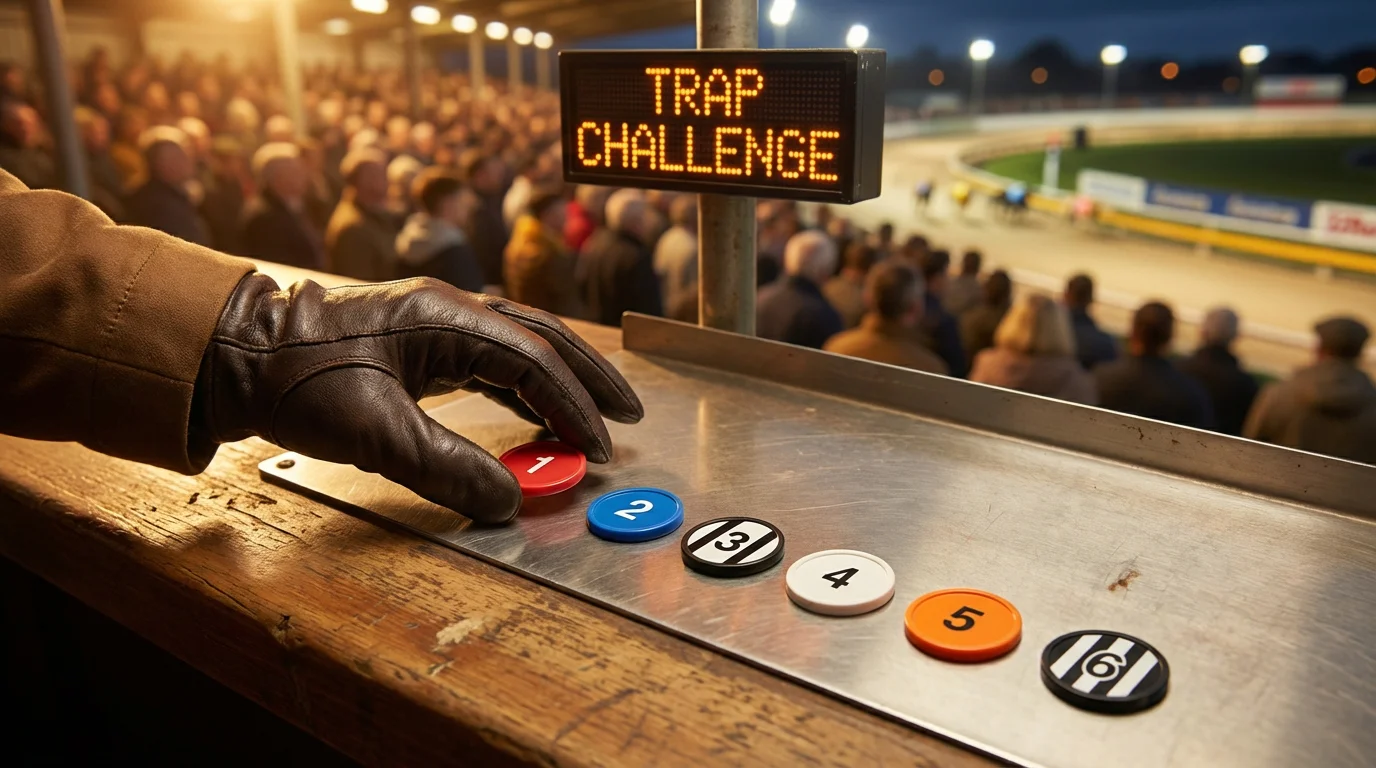
Backing a Trap, Not a Dog — The Card-Long Bet
Trap challenge betting inverts the usual approach to greyhound wagering. Instead of analysing individual dogs and backing specific runners, you choose a trap number and back it across every race on the card. Your trap earns points based on where the dog wearing that trap’s jacket finishes in each race — typically three points for a win, two for second place, and one for third. At the end of the meeting, the trap with the most points wins the challenge, and your bet pays out at fixed odds.
It is a simple concept, and that simplicity is part of its appeal. You do not need to study the racecard for every race on the meeting. You make one decision — which trap number — and then watch the results accumulate. For casual punters, trap challenges offer an engaging way to follow an entire evening’s racing with a single stake. For more analytical bettors, they present an interesting question: can you identify trap bias at a specific track on a specific night before the first race, and can you profit from that identification over a full card of racing?
How Trap Challenges Work
The mechanics are consistent across most bookmakers that offer the market, though minor variations exist. A standard trap challenge covers all races on a single meeting card — usually eight to twelve races at an evening fixture. Each trap number (1 through 6) is assigned a set of odds reflecting its expected performance over the full card. The favourite trap, typically determined by a combination of historical track bias data and the current card’s racecard form, might be priced at 5/2 or 3/1. The least favoured trap might be 7/1 or longer.
Points are awarded per race according to the finishing position of the dog drawn in each trap. The standard scoring system awards three points for a win, two for second, and one for third. Some operators use alternative scoring systems — five points for a win, two for second, one for third — so check the specific rules at your bookmaker. After the final race, the trap with the highest cumulative score wins. Dead heats on points are settled either by countback (most wins) or by sharing the payout, depending on the operator.
Your bet is placed before the first race on the card. Once the meeting is underway, the trap challenge bet is live and you simply watch the results unfold. Some bookmakers display live leaderboards during the meeting, showing the cumulative points for each trap after each race — a feature that adds considerable engagement to an evening’s viewing.
Non-runners are handled by the reserve system. If a dog is withdrawn, the dog in the reserve trap takes its place, wearing the same jacket number. For trap challenge purposes, the replacement dog is treated as if it were the original runner — its results count toward the trap’s total. This means trap challenge bets are rarely voided due to withdrawals.
Strategy — Reading the Card for Trap Bias
The difference between a trap challenge bet placed with thought and one placed at random is the same difference that separates any informed bet from a coin flip. There are genuine factors you can assess before choosing your trap, even without analysing every individual race on the card.
Start with historical trap statistics at the track hosting the meeting. Over a sample of several hundred races, most UK tracks show some degree of trap bias. It might be modest — Trap 1 winning 18 percent of races against a theoretical 16.7 percent average — but across twelve races on a card, a two-percentage-point edge compounds meaningfully. Data providers and some bookmaker sites publish trap stats by track, and the Racing Post’s results archive can be filtered to generate your own numbers.
Next, consider the track conditions on the night. As covered in detail elsewhere, wet or dry sand changes the running surface in ways that can amplify or neutralise normal trap biases. A track where inside traps dominate in dry conditions might see that advantage diminish after heavy rain, when the churned-up inside rail becomes the slowest part of the surface. If you can check the weather forecast and recent track reports before placing your trap challenge bet, you have a meaningful informational advantage over the market.
A more labour-intensive but potentially rewarding approach is to scan the racecard for each race and tally how many of your chosen trap’s occupants are well-fancied. If Trap 2 contains three or four short-priced favourites across the twelve races while Trap 5 is loaded with outsiders, Trap 2 has a structural advantage in the challenge that may not be fully reflected in the odds. This requires reviewing the form, but at a surface level rather than the deep analysis you would apply to a single-race bet. You are looking for concentration of quality in one trap number, not dissecting every runner.
Where to Find Trap Challenge Markets
bet365 is the most prominent UK bookmaker for greyhound trap challenge betting, offering the market on most evening meetings and selected afternoon cards. The bet365 trap challenge interface displays the odds for each trap and allows quick, single-click selection. Other major operators including Betfred, Coral, and Ladbrokes offer trap challenge markets on selected meetings, though availability is less consistent than at bet365.
Betfair Exchange does not typically offer a dedicated trap challenge market, but the concept can be approximated on the exchange through individual race bets — though this loses the simplicity and single-stake appeal that makes the trap challenge attractive in the first place.
When comparing trap challenge odds across bookmakers, note that the overround — the bookmaker’s built-in margin — varies between operators. A market where the six traps are priced at 3/1, 7/2, 4/1, 4/1, 9/2, and 5/1 has a different margin from one priced at 5/2, 3/1, 7/2, 4/1, 4/1, and 9/2. The lower-margin market gives you better value on every trap. If you have multiple bookmaker accounts, always compare before placing.
The Long Card — Trap Challenges as Entertainment and Education
Trap challenges occupy an interesting space in greyhound betting. They are casual enough to serve as an entertainment bet — a single stake that keeps you engaged across a full evening’s card without the analytical demands of race-by-race betting. But they are also analytical enough to reward the bettor who takes the time to assess track bias, weather conditions, and the distribution of form across trap numbers.
For developing greyhound bettors, trap challenges offer an additional benefit: they encourage you to watch a full meeting and observe how different traps perform across a range of race grades and distances at the same track on the same night. That observation builds track knowledge that is difficult to acquire any other way. You start to see patterns — which traps consistently produce fast starters, which traps suffer at certain bends, how conditions affect the inside versus the outside — and that knowledge feeds back into your regular race-by-race analysis.
Keep stakes modest on trap challenges. The outcomes are determined by a combination of form, bias, and randomness across many races, and no amount of pre-card analysis eliminates the variance. A few pounds on a trap challenge is a reasonable cost for an evening’s engagement with the sport. Larger stakes are hard to justify when the bet’s outcome depends on twelve separate events, many of which you have limited control over predicting.