How to Read a Greyhound Racecard
Best Greyhound Betting Sites – Bet on Greyhounds in 2026
Loading...
The Racecard Is Your Edge — If You Know How to Read It
Everything the bookmaker knows is on the racecard. Everything you need is too. The problem is that most punters treat the racecard like a menu — they scan it for a name they recognise, a short price, or a trap number they feel good about, and move on. That approach leaves most of the available information untouched.
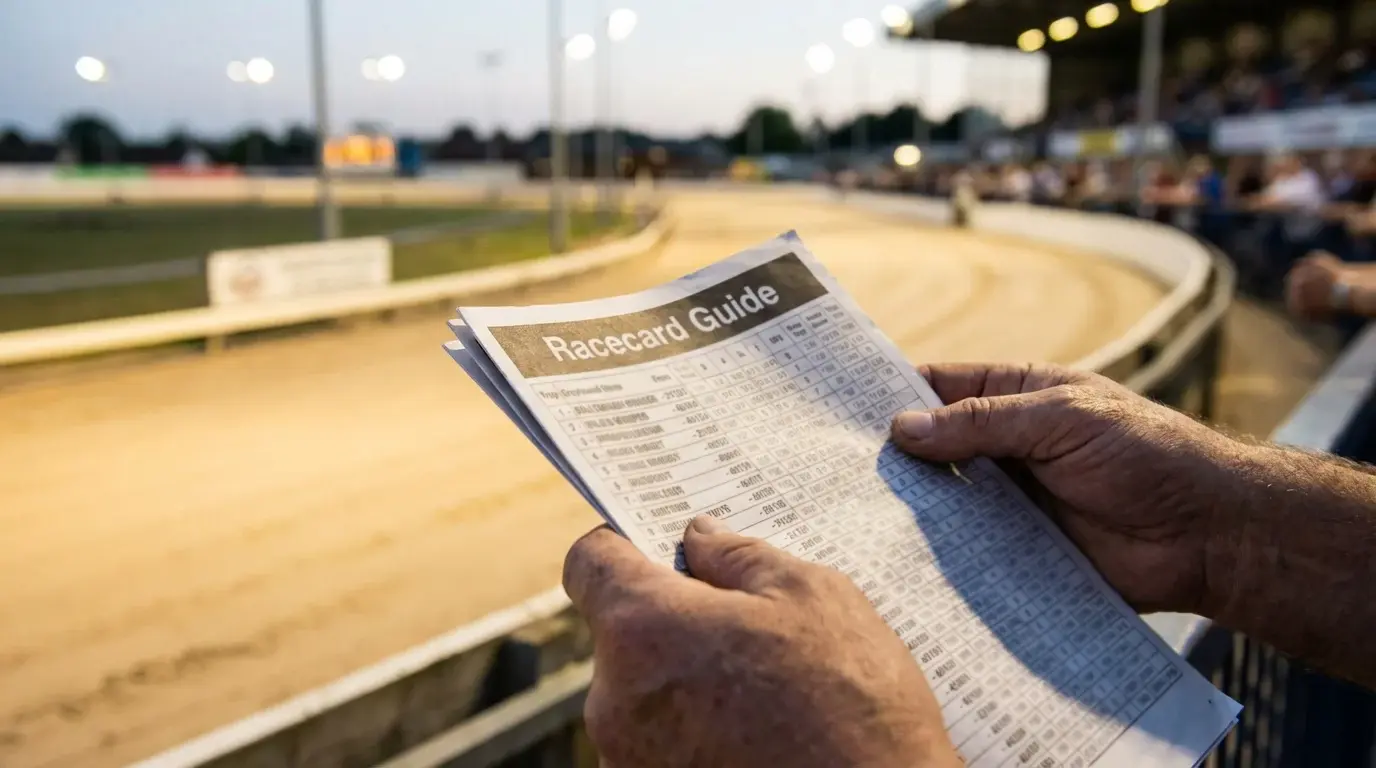
A UK greyhound racecard packs an extraordinary amount of data into a compact format. Trap numbers, colour-coded jackets, form figures, sectional times, best recorded times, weights, trainers, and running comments — all compressed into a few lines per runner. Each field tells you something specific about the dog’s recent history and likely race behaviour. Individually, these data points are interesting. Together, they form a diagnostic picture of how a race is likely to unfold.
The difference between a casual punter and a methodical one is not talent or insider knowledge. It is simply the discipline to read the card properly before reaching for the wallet. This guide walks through every section of a standard UK racecard, explains what each field means, and shows how to combine the information into a coherent pre-race assessment.
Anatomy of a UK Greyhound Racecard
Dog Name, Trap and Colour
Start top-left, work right. Every field has a purpose. The first elements you will see are the trap number and the dog’s name. In UK greyhound racing, there are six traps per race, each assigned a specific jacket colour that is standard across all GBGB-registered tracks. Trap 1 wears red, Trap 2 blue, Trap 3 white, Trap 4 black, Trap 5 orange, and Trap 6 wears black and white stripes. If a reserve runner replaces a withdrawn dog, it wears the same trap colour but with an additional “R” on the jacket.
The trap number is not random. It is assigned by the racing manager based on the dog’s running style. A dog that hugs the inside rail will typically be drawn in Trap 1 or 2. A wide runner gets Trap 5 or 6. Middle-running dogs fill Traps 3 and 4. This seeding system means the trap draw itself contains information — it tells you how the racing manager expects the dog to run, which is based on the dog’s previous racing behaviour at that track.
Beneath or alongside the name, you will often find the dog’s sire and dam, its colour (brindle, fawn, black, etc.), sex, and date of birth. The age matters more than most punters think. Dogs typically peak between 28 and 36 months. A two-year-old in a field of experienced three-year-olds might be improving rapidly. A four-year-old in the same field might be entering the decline phase. The racecard gives you this context if you look for it.
Form Figures and Recent Results
The form figures are the most referenced section of the racecard, and for good reason — they give you a compressed history of the dog’s last six runs. Each number represents a finishing position: 1 for first, 2 for second, and so on down to 6 for last. A form line reading 211342 tells you the dog won two of its last six races, placed second twice, finished third once, and fourth once. That is a solid, competitive performer.
But the numbers alone are only part of the story. Context changes everything. A “1” achieved in an A7 grade race against moderate opposition carries different weight from a “1” in an A3. A “4” where the dog was bumped at the first bend and lost three lengths is fundamentally different from a “4” where the dog had a clear run and simply was not fast enough. The form figures tell you what happened. The race remarks, which we will cover shortly, tell you why.
Look for patterns rather than isolated results. Three consecutive improving positions (say, 5-3-2) suggest a dog that is finding its form or has benefited from a drop in grade. A sequence that deteriorates (1-2-4-5) might indicate an injury developing, an unfavourable grade promotion, or simply a dog that peaked and is now declining. Consistency matters too. A form line of 222222 is not glamorous, but it tells you this dog is a reliable placer — useful information for each-way and forecast betting.
Best Time, Race Distance and Grade
Adjacent to the form figures, the racecard displays the dog’s best time at the specified distance and the grade of the race in which it was recorded. This is where the data gets genuinely useful for comparative purposes, but also where it can mislead the unwary.
A dog’s best time is its fastest recorded run over a given distance at a given track. If you are looking at a 480-metre race at Nottingham and one dog’s best time is 28.90 while another’s is 29.30, the first dog has clearly demonstrated superior pace. But — and this is critical — that best time was recorded under specific conditions. It might have been achieved on a fast, dry track on a summer evening when the sand was firm. If tonight’s race is on a rain-softened surface, the gap between those two times might narrow or even reverse. Fast-track times do not automatically transfer to slow-track conditions.
The grade in which the best time was set also matters. A time posted in an A2 race against strong competition holds more weight than the same time posted in an A6 where the dog had an uncontested lead from the first bend. Race dynamics affect times. A dog running unopposed at the front will often post faster times than a dog that has to navigate traffic, even if the second dog has equal or greater raw ability.
For meaningful comparison, focus on times posted at the same track, over the same distance, in similar grades, and ideally under similar conditions. A dog whose recent times are within half a second of its best is running near peak. A dog whose recent times are a full second slower has either regressed or is carrying a problem.
The racecard will also show the race distance and grade code — for example, “A4 480m” means a middle-distance graded race at grade 4 over 480 metres. Cross-referencing this with each dog’s form at the same distance is essential. Some dogs are versatile across distances. Many are not. A dog with strong sprint form entered in a staying race is as likely to fade as it is to lead.
Decoding Race Remarks and Abbreviations
Three letters can change your entire read of a dog’s form. The race remarks section, sometimes called the running comment or race comment, appears alongside or below the form figures and provides a brief coded description of how the dog ran in each of its recent outings.
The most common abbreviations you will encounter on UK racecards are these. QAw means the dog broke quickly from the traps — it showed sharp early speed and was among the leaders from the start. This is a significant positive, particularly in sprint races and on tight tracks where the first bend comes early. A dog with QAw in three of its last four runs is a consistent fast starter, and that trait is worth backing at tracks where early pace translates to race wins.
SlAw is the opposite: slow away. The dog was sluggish out of the traps and lost ground in the opening strides. Slow beginners face an immediate disadvantage in greyhound racing because recovering lost ground in a short race is difficult. However, SlAw can also indicate a dog that finishes strongly — if it was slow away but still finished second, its closing speed might be better than the result suggests.
ALd means the dog always led. It broke well, reached the first bend in front, and stayed there throughout. This is the dream running comment for any bettor backing that dog, but it also means the dog has not been tested under pressure from behind. If it draws an unfavourable trap and cannot lead, its form may look very different.
Bmp (bumped) and Crd (crowded) indicate the dog was physically interfered with during the race. A bumped or crowded runner’s finishing position should be read with heavy discount — the result does not reflect the dog’s ability because it was compromised by racing incidents. If a dog finished fifth but the remark says “Bmp1, Crd3” (bumped at bend one, crowded at bend three), that fifth-place finish is essentially invalid as a form indicator. This is one of the most valuable pieces of information on the entire racecard, and it is the one most casual bettors ignore.
RnOn (ran on) and Fin (finished well) both indicate the dog was gaining ground in the closing stages. These dogs are often better than their final position suggests, particularly over longer distances where stamina plays a greater role. EvCh (every chance) means the dog had a clear run and fair opportunity but could not win — which is a genuine negative, because it means the result was a true reflection of ability rather than the product of bad luck.
Other common abbreviations include Mid (middle running), Rls (railed), W (wide), and Ld1 through Ld4 (led at specific bends). Each adds a piece to the puzzle of how the dog ran.
From Racecard to Bet — Putting It All Together
Reading the card is not about finding the winner. It is about eliminating the losers. In a six-dog field, if you can confidently rule out two or three runners based on racecard analysis, your remaining selections are already better than a blind pick.
Imagine a six-dog race at a standard UK track. You open the racecard and begin working through each runner. The dog in Trap 1 has form figures 111231 and race remarks showing QAw in four of its last six runs. Best time is close to the grade A3 standard. This is clearly the form horse — fast away, consistent, and graded appropriately. But the price is likely to reflect all of that: expect a short-priced favourite.
Trap 3 shows form of 342653 and a best time two tenths slower than the Trap 1 dog. The remarks show Bmp1 in two of the last three runs. That is a dog that has been physically disrupted and whose form figures do not reflect its actual capability. If it gets a clear run tonight — and the middle trap draw might help it avoid early crowding — it could outperform its odds significantly.
Trap 5 has been promoted from A5 to A4 after two consecutive wins. The best time was set in the A5, and the remarks show ALd in both wins. This dog is stepping up in class against faster opposition and has only proven it can win when leading. If it gets beaten to the first bend by the Trap 1 dog, its tactics are neutralised. The grade promotion could be premature.
Trap 6 shows declining form — 125546 — with recent times a full second slower than its best. No race remarks excusing the poor runs. This looks like a dog in genuine decline. Eliminate it.
Through this process you have not picked a winner. What you have done is assessed the field, identified which dogs have legitimate chances based on form, and flagged the value angle — the Trap 3 dog whose poor form might be masking genuine ability. That is the point of reading the card. The bet follows the analysis, not the other way around.
The Card Doesn’t Lie — But It Doesn’t Shout Either
The more cards you read, the less time you need to read them. Pattern recognition builds with repetition. After fifty or a hundred racecards, you will find yourself automatically scanning for the key signals — recent bumping remarks, improving form sequences, promoted dogs facing stiffer grades — without consciously working through each data point.
This is where racecard reading pays off not just per race but over an entire session. Greyhound racing runs every day of the year in the UK, with hundreds of races across daytime BAGS meetings and evening cards. The volume of data is enormous, but the patterns repeat reliably. Dogs that break fast keep breaking fast. Dogs that get bumped at tight tracks keep getting bumped until they change traps or tracks. Dogs in declining form rarely reverse without a rest or a grade drop.
The racecard does not predict the future with certainty. What it provides is a structured, objective foundation for decision-making that replaces guesswork with evidence. Every serious greyhound bettor reads the card before they read the odds. The order matters. If you look at the price first, you anchor your analysis to the market’s view. If you read the card first, you arrive at the odds with an independent assessment, and that independence is where value lives.
Keep reading the cards. The information does not advertise itself and does not guarantee profits, but it consistently rewards the punters who take the time to understand what it is telling them.