Major UK Greyhound Races 2026
Best Greyhound Betting Sites – Bet on Greyhounds in 2026
Loading...
The Races That Define the Sport
Most greyhound betting happens on Tuesday evening graded races at Romford or midday BAGS meetings where the fields are predictable and the prize money barely covers kennel costs. That is the bread and butter of the sport, and there is nothing wrong with it. But scattered across the calendar are a handful of events that operate on a completely different level — races where the best dogs from across the country and Ireland converge, where ante-post markets open months in advance, and where a single final can generate more betting turnover than an entire week of standard racing.
The English Greyhound Derby, the St Leger, the Oaks. These are not just prestige events for the sport’s insiders. They are the moments when greyhound racing intersects with mainstream betting attention, when bookmakers push promotions, when casual punters suddenly notice there is a dog racing section on their app. For anyone who bets on greyhounds regularly, understanding the major race calendar is not optional — it shapes the ante-post markets you can exploit, the form cycles you need to track, and the weeks when betting value shifts dramatically.
This guide covers the key events, their place in the calendar, and the betting angles each one creates.
English Greyhound Derby, St Leger and Oaks — The Big Three
English Greyhound Derby
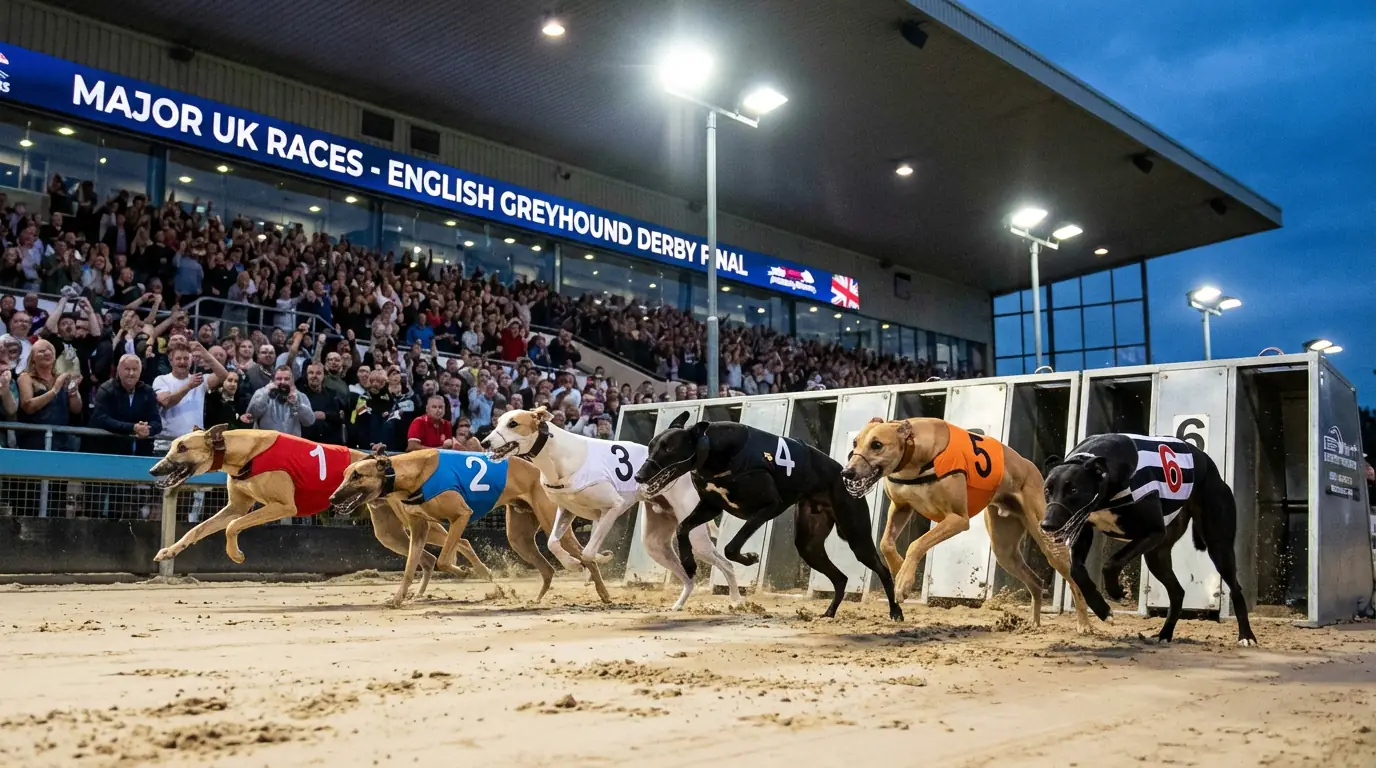
The Derby is the race. Held at Towcester Racecourse in Northamptonshire — the event’s home since 2021, following earlier stints at the venue from 2017 to 2018 — it remains the single most prestigious event in the sport. The final is run over 500 metres, and the 2026 prize for the winner stands at £125,000, a sum that dwarfs anything else on the UK greyhound calendar. The tournament format runs across several weeks: early rounds whittle down a large entry field through heats and quarter-finals, building toward a semi-final and six-dog final that draws national attention.
From a betting perspective, the Derby is unique because it creates a sustained ante-post market. Once entries are confirmed, bookmakers price up outright winner markets weeks before the first heat. Prices shift as dogs win or lose their heats, and the volume of money entering the market means odds move on genuine information rather than thin-market noise. The Derby also produces the year’s most analysed form lines — if a dog runs a fast heat time at Towcester, that time becomes a reference point for grading its ability for months afterward.
The St Leger
Where the Derby tests speed over a standard middle distance, the St Leger is a stayer’s race. Run over 715 metres at Dunstall Park in Wolverhampton for the 2026 edition, it demands a different type of dog — one with stamina, tactical patience, and the ability to sustain pace through the final 200 metres when sprinters fade. The St Leger has moved between venues over the decades — from Wembley to Wimbledon, then Perry Barr and Nottingham — and its location can shift between years, which adds an extra variable for bettors. Track familiarity matters more in a staying race where bend positioning and running lines play a bigger role.
Betting on the St Leger requires a different lens than the Derby. Form over shorter distances is less predictive here. You are looking for dogs with strong sectional times in the final third of their races, dogs that finish strongly rather than break fast. The ante-post market is typically less liquid than the Derby, which means odds can be more generous — but also more volatile. A strong trial run or a convincing heat performance can slash a dog’s price overnight.
The Greyhound Oaks
The Oaks is restricted to bitches and runs over a middle distance, typically 480 to 500 metres depending on the host venue. It occupies an interesting position in the calendar — often scheduled within weeks of the Derby, meaning some kennels face decisions about where to direct their best female runners. The Oaks field tends to be more competitive at the top end than casual observers expect, because the restriction to bitches removes the open-class males that dominate mixed events.
For bettors, the Oaks often delivers better each-way value than the Derby. The market is thinner, public attention is lower, and prices reflect less informed money. If you follow form through the heats, there are genuine opportunities to identify dogs whose odds do not match their ability — particularly in the early rounds where bookmakers price conservatively on limited data.
Seasonal Calendar of Key Events
UK greyhound racing does not follow a single season the way horse racing pivots around the Flat and National Hunt calendars. Racing runs year-round, and most tracks operate on continuous schedules. But the major events do cluster in recognisable patterns, and understanding this rhythm helps you plan your betting year.
Spring typically sees the opening rounds of the Derby, with heats running through late spring and the final in early summer. The Oaks often slots into a similar window. The St Leger tends to sit later in the year, usually between late summer and autumn, though its exact scheduling varies. Alongside these headline events, individual tracks run their own feature competitions throughout the year — the Romford Puppy Cup, the Hove Gold Cup, the Monmore Stayers — and these carry significant local prestige and decent prize funds.
The BAGS calendar is worth noting separately. British American Greyhound Services meetings run during weekday daytime slots and generate enormous betting volume despite their lower profile. While BAGS racing rarely produces headline events, major bookmakers build their daily greyhound markets around these meetings. The evening cards — broadcast on RPGTV and streamed by bookmakers — are where the graded racing takes place and where most of the serious form data accumulates.
For ante-post bettors, the calendar creates clear windows of opportunity. Derby outright markets typically open in spring, offering the longest odds and the highest risk. As heats progress, the field narrows and the market sharpens. The same pattern applies to the St Leger and Oaks on compressed timelines. Between the majors, feature races at individual tracks provide smaller-scale ante-post opportunities that often fly under the radar of mainstream bookmaker attention.
Ante-Post Betting Angles for Major Races
Ante-post betting on greyhound racing works differently from horse racing in one crucial way: the information gap is smaller but the risk is higher. In horse racing, you might back a Derby favourite months out based on pedigree and trials. In greyhound racing, you are typically working with a dog’s graded form at its home track, perhaps a trial at the tournament venue, and the trainer’s reputation. The dog could get injured, fail to qualify, or simply not handle the track surface on the night.
The trade-off is that ante-post prices on greyhounds can be exceptionally generous. Bookmakers price up large fields with limited data, and the early-round results produce violent market corrections. A dog priced at 25/1 before the first heat can be cut to 6/1 after a fast qualifying time. If you have done your homework and identified that dog’s potential before the market catches up, the value is real.
A practical approach is to separate your ante-post strategy into two phases. Phase one is pre-tournament: study the entry list, focus on dogs with strong recent form at the relevant distance, and look for track specialists if the venue is confirmed. Place small stakes at the longest available prices, accepting that some of these bets will lose before the dog even runs. Phase two is between rounds: once heats have been run, the form picture clarifies rapidly. Dogs that won their heats comfortably or posted fast times will shorten, but the real opportunity is in heat losers who ran well in defeat — a dog that finished second by a short head in a fast heat may still have a strong chance of qualifying and improving.
One rule that matters enormously: ante-post bets on greyhound racing are typically all-in. If your dog does not run, the stake is lost. There is no non-runner refund unless the bookmaker explicitly states otherwise. This is the fundamental risk of ante-post greyhound betting, and it should dictate your staking. Never commit a significant portion of your bankroll to an ante-post position on a single dog, no matter how strong the form looks.
Beyond the Card — Why the Big Nights Matter
There is a version of greyhound betting that never looks beyond the next BAGS meeting. It is a perfectly valid way to approach the sport — consistent, data-driven, focused on daily value. But the major races offer something that Tuesday afternoon at Swindon does not: narrative. The English Greyhound Derby final is six dogs that have survived weeks of elimination, trained by people who have built their year around this single race, competing for a prize that can define a kennel’s decade.
That narrative is not just entertainment — it is information. A dog that peaks for the Derby final has been managed toward that moment. Its trial times, its heat performances, its draw in the semi-final — all of these are data points that tell you whether the dog is improving, holding form, or fading under the pressure of repeated racing. The major events compress months of form into weeks, and for the attentive bettor, that compression creates clarity.
Mark the dates. Follow the entries. Watch the heats. The major races are where greyhound betting stops being a punt and starts feeling like a sport you understand.