Greyhound Racing Tips & Betting Strategy — Expert UK Guide
Best Greyhound Betting Sites – Bet on Greyhounds in 2026
Loading...
Strategy Isn’t a System — It’s a Discipline
There are no secret systems — there are punters who do the work and punters who don’t. Every year, a new “guaranteed greyhound system” circulates on forums and tipster pages, promising consistent profits through a mathematical formula or a staking progression that supposedly can’t lose. They all share the same fatal flaw: they assume a predictable structure in a sport defined by unpredictability. Six dogs on a sand track, thirty seconds of racing, and a first bend where anything can happen — no formula survives that environment intact.
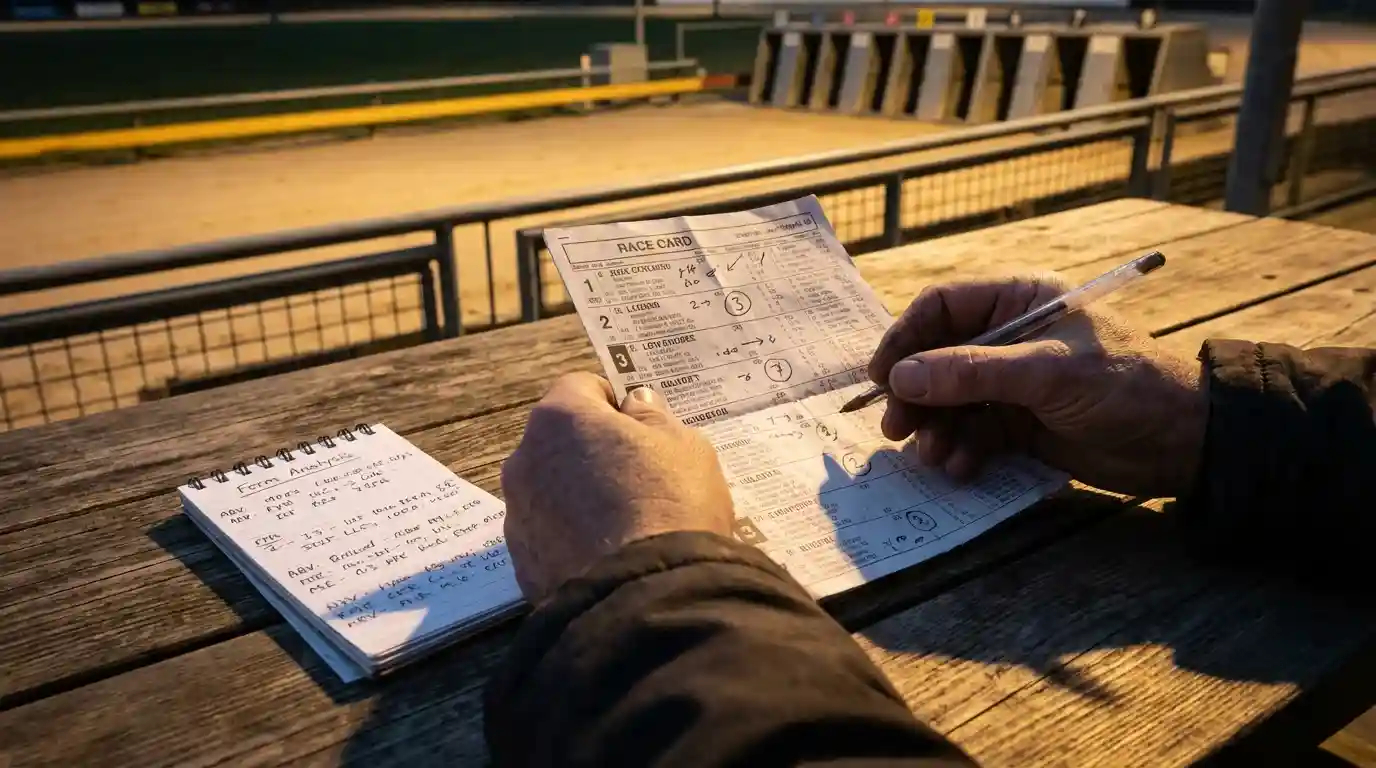
What does survive is process. Strategy in greyhound betting isn’t a rigid set of rules that produce winners on demand. It’s a discipline built from form analysis, trap draw assessment, odds evaluation and stake management, applied consistently over hundreds of races. The punter who reads every racecard, understands every trap draw, checks the track conditions and takes the right price at the right time will not win every bet. They will, over the long run, outperform the one who picks names at random and hopes for the best.
This guide lays out what that process looks like in practice — from the granular detail of interpreting race remarks to the broader discipline of race selection and bankroll management. None of it is complicated. All of it requires effort.
Reading Greyhound Form Like a Professional
What the Form Figures Actually Tell You
Form figures are shorthand. The detail underneath them is where the edge lives. A string of recent finishing positions — 2-1-3-1-4-2 — gives you the surface picture: a dog that’s been competitive, winning twice in its last six starts. But raw positions without context are misleading. A third-place finish in an A3 race at Romford against strong-form opposition is a stronger performance than a first-place finish in an A8 at a minor track. The grade, the track, the quality of the field, and the circumstances of the run all matter as much as the number itself.
Time comparisons add another dimension. Most racecards display a dog’s best time at the given distance, and comparing times within the same grade and track combination gives you a reliable measure of relative ability. A dog with a best time of 28.50 seconds over 480 metres at Nottingham is measurably faster than one clocking 29.10 over the same trip at the same venue, assuming comparable conditions. Where this comparison becomes unreliable is across different tracks — circuit sizes, trap configurations and sand conditions vary, making inter-track time comparisons an imprecise exercise at best.
Sectional Times and Race Remarks
Sectional times — the split times taken at specific points during a race, typically at the first bend and at intermediate markers — tell you about a dog’s speed profile in a way that finishing times alone cannot. A dog with a fast first-sectional time is an early-pace runner, one that gets out of the traps quickly and leads into the first bend. A dog with a slower first split but a faster closing sectional is a finisher that runs on through the field. Matching a dog’s sectional profile to the race distance and trap draw is one of the more precise analytical tools available to a greyhound bettor.
Race remarks encode how a run actually unfolded. The abbreviations are standardised across UK racing: QAw (quick away) means the dog broke fast from the traps and led early. SlAw (slow away) is the opposite — a tardy break that cost positions. ALd (always led) describes a front-running performance from start to finish. Bmp (bumped) and Crd (crowded) indicate interference during the race. RnOn (ran on) means the dog finished strongly, gaining ground in the closing stages. Fin (finished well) is similar but emphasises late effort.
The value of race remarks lies in distinguishing between genuine form and circumstantial results. A dog that finished fourth but was recorded as Bmp1 Crd2 (bumped at the first bend, crowded at the second) ran a much better race than the bare position suggests. Conversely, a dog that won but was noted as “Led, unchallenged” might have benefited from a weak field rather than producing an exceptional performance. Weighting a clear run against an interfered-with performance is one of the most important — and most overlooked — skills in greyhound form analysis.
Improving and Declining Form Patterns
Greyhound careers follow a predictable arc. Young dogs — typically under thirty months — are often still improving, gaining race fitness and learning to handle the traps, the bends and the traffic of competitive racing. A young dog whose recent form shows a pattern of improving positions (6-4-3-2) is one to watch: the trajectory matters more than any single result. These dogs are often underpriced by the market because their most recent finishing position doesn’t reflect their current ability.
At the other end of the spectrum, veteran dogs past their peak — usually beyond forty months, though this varies by individual — can show a gradual decline that the form figures reveal over time. Finishing positions that were consistently in the top two start slipping to third and fourth. Best times that once led the graded field now sit in the middle. A dog that drops a grade isn’t necessarily a value play at the lower level; it might be a dog in decline that the racing manager has correctly regraded to reflect diminished ability.
Grade movement itself is a valuable signal. A dog promoted from A6 to A4 within two months has been performing above its grade consistently — the racing manager doesn’t promote on a single win. Equally, a dog relegated from A3 to A5 in a short period is one the system has identified as unable to compete at the higher level. Tracking grade movement alongside form figures gives you a more complete picture of whether a dog is ascending, plateauing, or declining — and the odds should reflect where in that cycle the dog currently sits.
Using Trap Draw as a Betting Edge
Seeding — How Traps Are Assigned
Traps aren’t drawn at random — they’re assigned. That changes everything about how you should think about the trap draw in greyhound racing. The racing manager at each track allocates traps based on each dog’s running style, using trial data and recent race performances to place runners where they’re most likely to run without interference. A railer — a dog that naturally hugs the inside rail through the bends — will typically be seeded into trap 1 or 2. A wide runner, one that takes a wider path and often has the pace to sustain it, gets trap 5 or 6. Middle-seed dogs, whose running style doesn’t strongly favour either rail, end up in traps 3 or 4.
This seeding creates structure within every race. It means the dog in trap 1 is likely to run along the rail, the dog in trap 6 is likely to go wide, and the middle-trap dogs will jostle for position between them. The first bend is where these paths converge, and the relative pace and positioning of each dog at that point is heavily influenced by the trap assignment. A fast railer in trap 1 at a track with a short run to the first bend has a significant structural advantage: it takes the shortest path to the bend and arrives first if its early speed holds. A slow beginner in the same trap has the opposite problem — it gets swallowed by faster dogs coming from the middle and outside before the bend is reached.
Track-Specific Trap Bias
Different tracks produce different trap biases, and treating all tracks the same is one of the most common analytical errors in greyhound betting. The geometry of the track — the length of the run from the traps to the first bend, the tightness of the bends, the width of the back straight — determines which trap positions carry a structural advantage.
At tracks with tight bends and a short run-up to the first bend, inside traps have a persistent advantage over large samples. The inside dog takes the shortest route to the bend and, if it has reasonable early pace, arrives there first with a clear rail to follow. At wider tracks with longer straights and more gradual bends, the advantage evens out — wide runners have more room to operate, and the first-bend congestion that punishes outside-drawn dogs at tighter circuits is less of a factor.
Weather amplifies these patterns. Rain changes the sand surface, and the effect isn’t uniform across the track. At some venues, wet conditions firm up the inside rail and exaggerate the advantage for inside-drawn railers. At others, standing water on the inside pushes the running line wider, temporarily neutralising the inside-trap bias. Checking recent trap statistics for the specific track and conditions you’re betting on is one of the simplest and most effective pieces of pre-race analysis available. Most bookmaker sites and independent form services publish trap-win percentages by track, and comparing these against the day’s conditions — weather, card strength, specific dogs drawn — takes minutes and can directly inform your selections.
Track Conditions — The Variable Most Punters Ignore
The track looks the same every night. It doesn’t race the same. Every UK greyhound track uses a sand surface, but the behaviour of that surface changes with the weather, the temperature, the time of day and how recently it’s been maintained. These variables affect race times, running lines and, critically, which dogs and which traps gain or lose an advantage.
Wet sand is the most significant condition change. Heavy rain compacts the surface, which generally produces faster race times — the firmer ground gives dogs better grip through the bends and reduces the energy lost to soft, shifting footing. But wet conditions also change the balance of advantage between running styles. Dogs with stamina and a strong finish benefit from a firmer surface that lets them sustain pace deep into the race. Dogs that rely on explosive early speed can find that the wet surface doesn’t provide the same springboard out of the traps.
Dry sand, particularly on warm summer evenings, tends to be looser and slower. Race times extend, and front-runners who build an early lead have a slight advantage because the softer surface makes closing from behind harder work. Track maintenance — harrowing between races — can also affect conditions during a meeting, occasionally changing the going between the first and last races of the card.
Time of day is an underappreciated factor. Afternoon BAGS meetings in summer run on warm, dry sand. Evening meetings at the same track can be on cooler, firmer ground that races differently. Dogs with form exclusively from afternoon meetings might not reproduce that form on a cooler evening surface, and vice versa. Checking the weather forecast for the track’s location on race day, and cross-referencing it with the dogs’ form under similar conditions, is a small step that most casual bettors skip entirely — which is precisely why it’s worth doing.
Picking Your Races — Quality Over Quantity
The best greyhound punters skip more races than they bet on. With over two hundred races available on a typical UK racing day, the temptation is to treat every race as an opportunity. It isn’t. Many races on a BAGS card are low-grade affairs where the form is thin, the dogs are inconsistent, and the margins between runners are too narrow for any confident assessment. Betting on these races is entertainment, not strategy.
Graded races with full six-dog fields are the most predictable category for strategic betting. The grading system ensures a level of competitive parity, and the form data for graded dogs at their home track is directly comparable. You’re working with a controlled set of variables: same grade, same track, same distance, recent form under known conditions. This is where disciplined form analysis produces its best results, because the data is rich enough to support a genuine assessment of each dog’s chances.
Races with late reserves — replacement dogs brought in after a withdrawal — are worth approaching with caution. A reserve runner might be unfamiliar with the track, out of regular race fitness, or drawn in a trap that doesn’t suit its running style. The market often struggles to price reserves accurately, which can create value in either direction — but it also introduces an unpredictable element that undermines careful pre-race analysis.
Open races, which sit above the grading system and attract dogs from multiple tracks, present a different challenge. The form data is richer because higher-profile dogs tend to be better documented, but comparing dogs from different circuits adds uncertainty. If you’re confident in cross-track form assessment, open races can be profitable. If you’re still building that skill, stick to graded races at tracks you know well. Having a strike list — a pre-selected set of races you’ve identified as worth betting on — is a more productive approach than scanning the full card and betting on whatever catches your eye. Decide before the first race which meetings you’ll focus on, and hold the discipline to leave the rest alone.
Staking Plans That Survive a Full Race Card
Level Stakes — The Foundation
A staking plan isn’t exciting. That’s the point. Level stakes — betting the same fixed amount on every selection — is the simplest and most robust approach for greyhound racing. Set your stake at one to two percent of your total bankroll per bet. On a hundred-pound bank, that’s one or two pounds per selection, every time, regardless of how confident you feel about the dog or how badly the last three bets went.
The discipline of level stakes is specifically designed for high-frequency betting environments. When races come every fifteen minutes and you might place ten or fifteen bets in a session, the temptation to scale up after a losing run or to load up on a “sure thing” is powerful. Level stakes remove that decision entirely. You bet the same amount. Always. The emotional architecture of chasing — the instinct to increase stakes to recover losses — has no mechanism to operate through. A bad run costs you ten or fifteen level-stake units, not a catastrophic escalation that wipes out the bank.
Percentage-of-Bank Staking
An alternative that offers slightly more sophistication is percentage-of-bank staking. Instead of a fixed pound amount, you bet a fixed percentage of your current bankroll — say two percent. On a hundred-pound bank, your first bet is two pounds. If you lose, the bank drops to ninety-eight pounds and your next bet is one pound ninety-six. If you win at 3/1, the bank rises to a hundred and six pounds and your next bet is two pounds twelve.
The advantage of this approach is automatic scaling. Stakes decrease as you lose, providing natural protection against drawdowns. Stakes increase as you win, compounding your profits without manual adjustment. The disadvantage is the arithmetic: you need to recalculate your stake before every bet, which is a minor friction that some punters find disruptive to their workflow. For greyhound betting, where the pace of action is fast and the time between bets is short, level stakes is often the more practical choice. Either system works. The principle behind both — consistency and predefined risk limits — matters more than the specific method.
Why Progression Systems Fail in Greyhound Racing
Martingale staking — doubling your stake after every loss — is the most common progression system, and it’s catastrophically unsuited to greyhound racing. The theory sounds plausible: if you keep doubling, eventually you’ll win and recover all previous losses plus one unit of profit. The reality is that losing streaks in greyhound racing are long and frequent enough to blow through any realistic bankroll.
Consider a modest starting stake of two pounds on even-money selections. After five consecutive losses — which is not unusual in greyhound racing — your sixth bet requires sixty-four pounds to continue the progression. After eight losses, you’d need five hundred and twelve pounds. On a hundred-pound bank, you’re wiped out before the sequence completes. And this assumes even-money bets, which carry a roughly fifty percent win probability. On longer-priced selections, losing streaks extend further, and the required stakes escalate faster.
Greyhound racing’s fifteen-minute cycle amplifies the danger. In football, a Martingale progression might play out over weeks, giving you time to recognise the risk and stop. In greyhound racing, five losing bets can happen in seventy-five minutes. The speed at which the system collapses isn’t a theoretical concern — it’s a practical one that plays out every day at tracks across the UK. Any staking system that increases your exposure after a loss is a system designed to fail in a high-frequency, unpredictable environment. Flat stakes, whether level or percentage-based, are the only approaches with the structural resilience to survive a sustained period of greyhound racing.
Niche Strategies for Experienced Punters
Lay Betting on the Exchange
These strategies aren’t for everyone. They’re for punters who’ve done the work on the basics first. Lay betting — betting against a dog winning — is available on exchanges like Betfair and inverts the normal proposition. Instead of identifying a winner, you’re identifying a likely loser. In a six-dog field, five of them are going to lose. The question is whether you can consistently identify one that the market has overpriced.
The ideal lay candidate is a short-priced dog with identifiable weaknesses that the market hasn’t fully absorbed: poor recent form masked by its grade or reputation, an unfavourable trap draw for its running style, or a track and distance that doesn’t suit its speed profile. Laying at short odds — say 2/1 or 5/2 — means your liability on each bet is relatively small: if you lay a dog at 2/1 for a one-pound stake, you lose two pounds if it wins and profit one pound if it doesn’t. The strike rate for lay bets at these prices should be high, because you’re betting against dogs that lose most of the time anyway. But the margin is thin, and a single winner against your lay position can erase several small profits. Strict selection criteria and consistent staking are essential.
Trap Challenge and Match Bet Strategies
Trap challenge markets — betting on which trap number produces the most winners across a full card — reward a macro view of the track rather than a race-by-race analysis. The strategy is data-driven: review the track’s historical trap-win percentages, adjust for current conditions (weather, time of day, card composition), and back the trap most likely to produce a disproportionate number of winners. At tracks with strong persistent biases, trap challenges can offer consistent value, particularly when the market’s pricing doesn’t fully reflect the current conditions.
Match bets — head-to-head wagers on which of two dogs finishes ahead — eliminate the field and let you focus purely on relative form. The strategy is to identify race-specific mismatches: a dog with strong recent form and a favourable trap draw matched against one with declining form in an unsuitable trap. The beauty of match betting is its simplicity: you don’t need to predict the winner, just which of your two selections runs better. For races where you have a strong view on two dogs but little confidence about the rest of the field, match bets convert your analysis into a bet more efficiently than a standard win market.
Ante Post Value in Open Races
Ante post betting on major greyhound events — the English Greyhound Derby, the St Leger, the Oaks — is a different discipline from day-to-day race betting. Prices are available weeks or months before the event, and they’re typically more generous than they will be on race day, because the field is uncertain and the market is pricing in the risk of withdrawals and unknown form developments.
The value in ante post greyhound betting comes precisely from that uncertainty. If you identify a strong dog early — one with outstanding trial times, a favourable draw in early rounds, or a trainer with a history of peaking their runners for major events — you can take a price that may halve by the time the final approaches. The risk is equally real: ante post bets are all-in, meaning if your dog doesn’t run — whether through injury, elimination in earlier rounds, or any other reason — your stake is lost. There are no non-runner deductions. For this reason, ante post should be treated as a high-risk, high-reward addition to your betting portfolio rather than a core strategy. Small stakes, strong convictions, and a willingness to lose the bet entirely if things don’t develop as expected.
The Long Run — Why Process Beats Luck at the Track
Luck decides one race. Process decides a thousand. Over a single afternoon of racing, anything can happen: the form dog can bump at the first bend, a rank outsider can lead from trap to line, and the most carefully analysed selection can finish last because the hare ran a second slower than usual. None of that matters in the long run. What matters is whether the decisions you made — which races to bet on, which dogs to back, what price to take, how much to stake — were sound decisions repeated consistently over hundreds of races.
The punter who tracks their bets — recording selections, prices, stakes, results and profit-and-loss — will learn more in three months than the one who bets from memory for three years. Patterns emerge in the data that aren’t visible race by race: which tracks you assess most accurately, which bet types produce your best returns, which types of races your analysis struggles with. Greyhound racing, with its rapid cycle and statistical richness, is uniquely suited to this kind of systematic review. The races are short, the variables are knowable, and the sample sizes build quickly.
The temptation in greyhound betting is to treat each race as its own event, disconnected from everything before and after it. In one sense, that’s true — each race is statistically independent. But your approach to those races isn’t independent. It’s the product of habits, skills and discipline that either improve over time or don’t. The long run isn’t about getting lucky often enough. It’s about making decisions that are right often enough, at prices that are good enough, with stakes that are small enough to survive the inevitable stretches where nothing lands. That’s not a system. It’s a discipline. And it’s the only thing in greyhound racing that reliably works.